
Why the WetModule™?
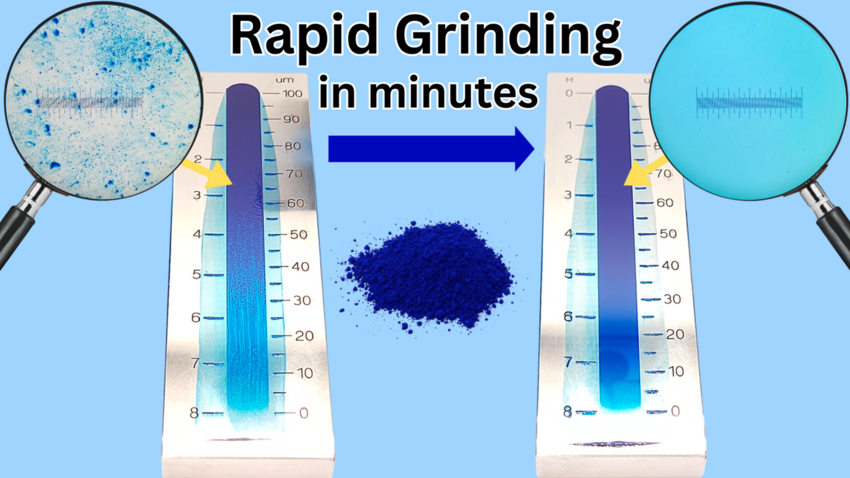
Faster Results
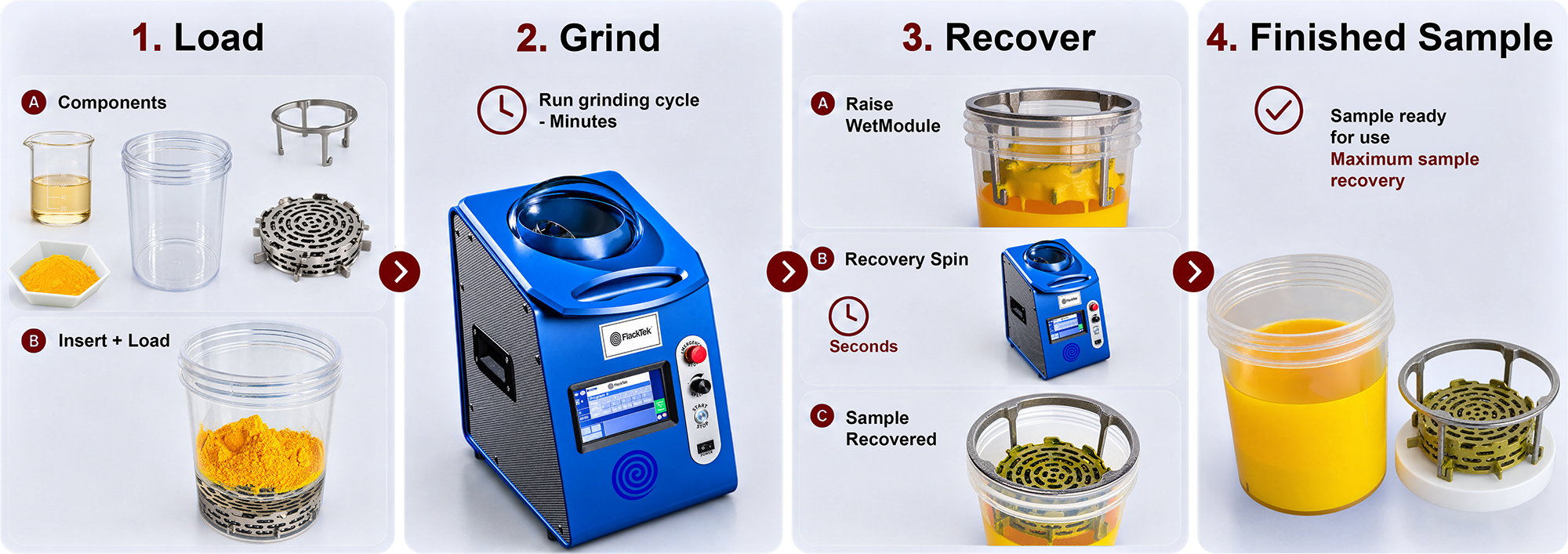
High-energy media motion generated by the FlackTek™ produces highly effective breakage and shear events, allowing WetModule™ processes to achieve in minutes what can require hours in conventional planetary, mixer mills, or other media-driven milling systems.
No Loose Media
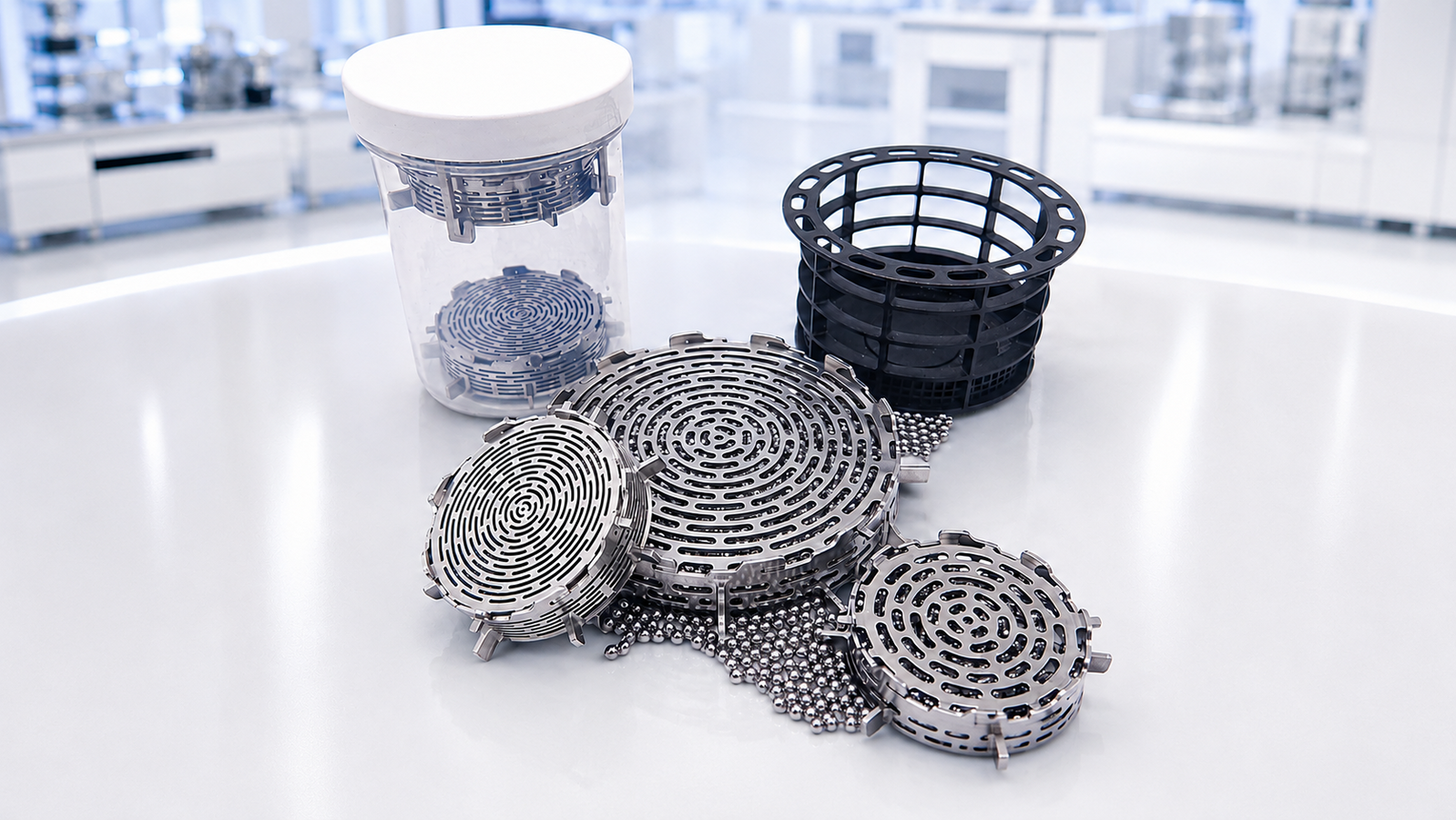
The WetModule™ keeps all grinding media contained inside the milling cage. This eliminates the need to manually separate large quantities of loose grinding balls from the finished sample and greatly simplifies handling and cleanup.
Maximum Sample Recovery
Once grinding is complete, the WetModule™ is raised to the recovery position above the bulk sample. A brief recovery spin uses centrifugal force to strip residual material from the media and cage, returning it to the bulk sample and maximizing recovery while minimizing product loss.
Exceptional Viscosity Range
From low-viscosity suspensions to thick pastes, the high accelerations generated by the FlackTek™ enable effective grinding across a broad viscosity range—well beyond the practical limits of traditional lower-energy systems.
Scalable from R&D to Production
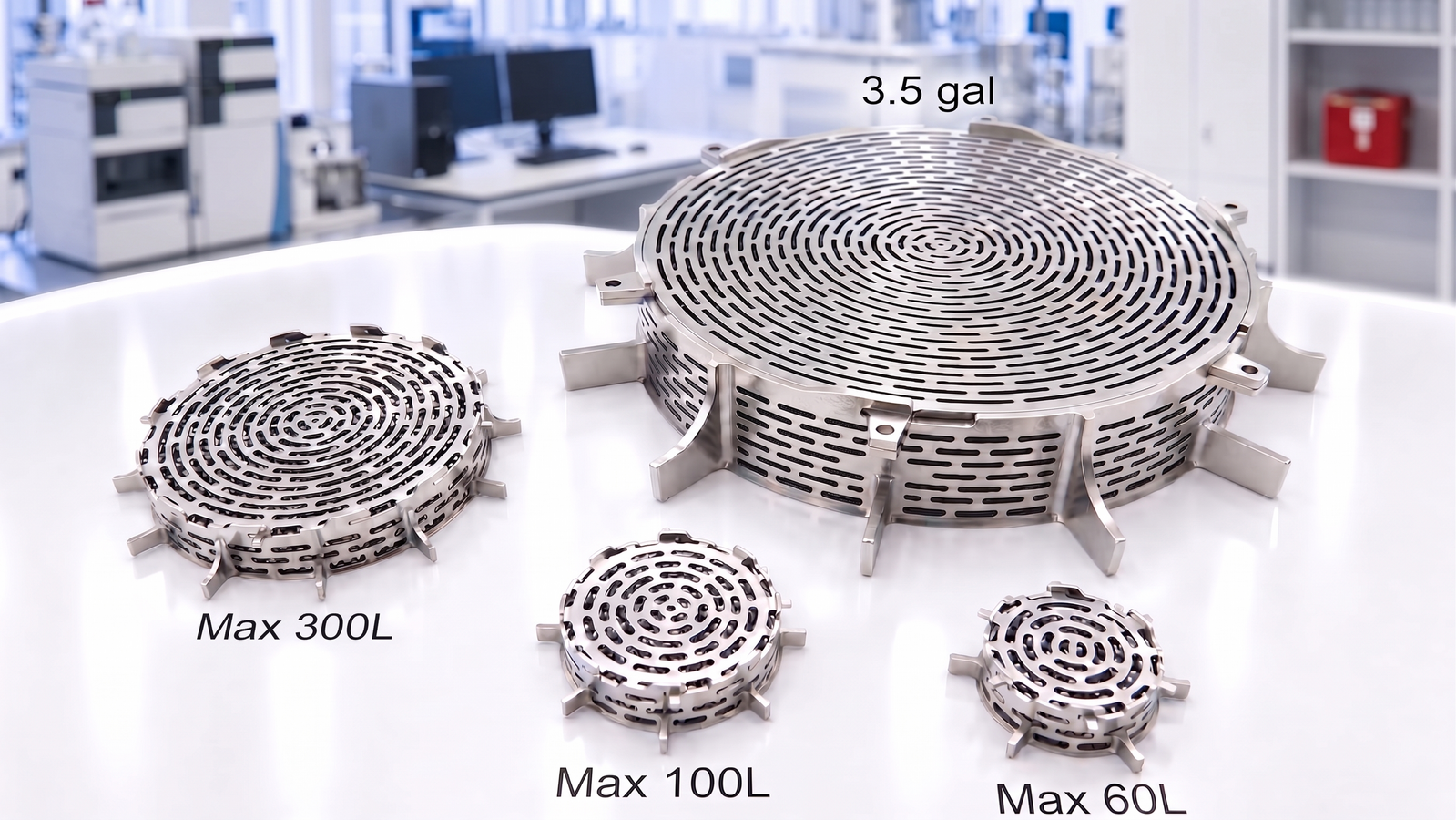
Available across a range of cup and machine sizes, the WetModule™ accommodates batch volumes from 20 mL to more than 14 L, supporting a seamless progression from laboratory R&D through pilot-scale and production processing.
Simple WetModule™ Workflow
The workflow remains simple even as the grinding mechanism changes: process the sample with contained media, raise the WetModule™, then use the recovery spin to return residual material to the bulk sample.
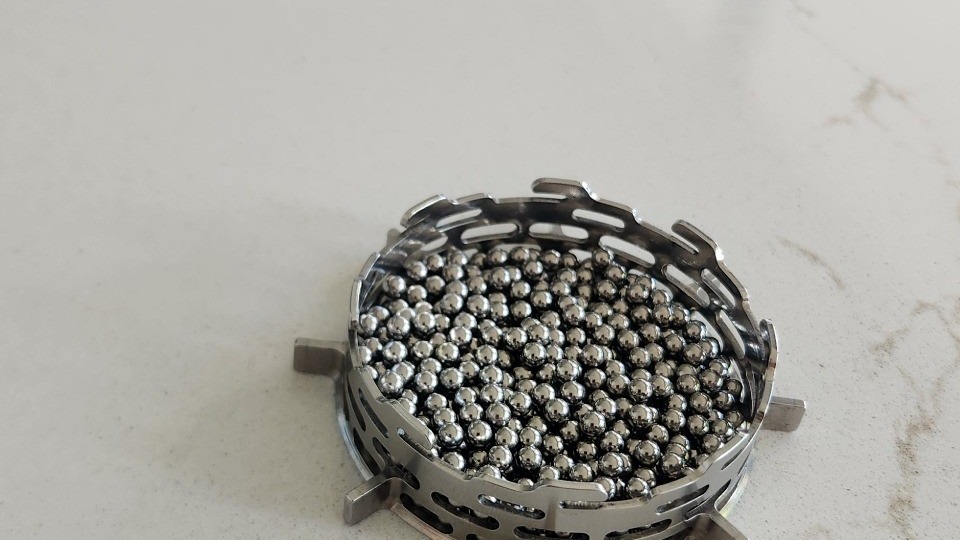
Two WetModule™ architectures.
Micro and Nano configurations use different media sizes to shift the processing window from larger starting particles toward finer final particle distributions.
WetModule™ Micro
- 3 mm grinding media
- 2.25 mm slot size
- Best for larger starting particles
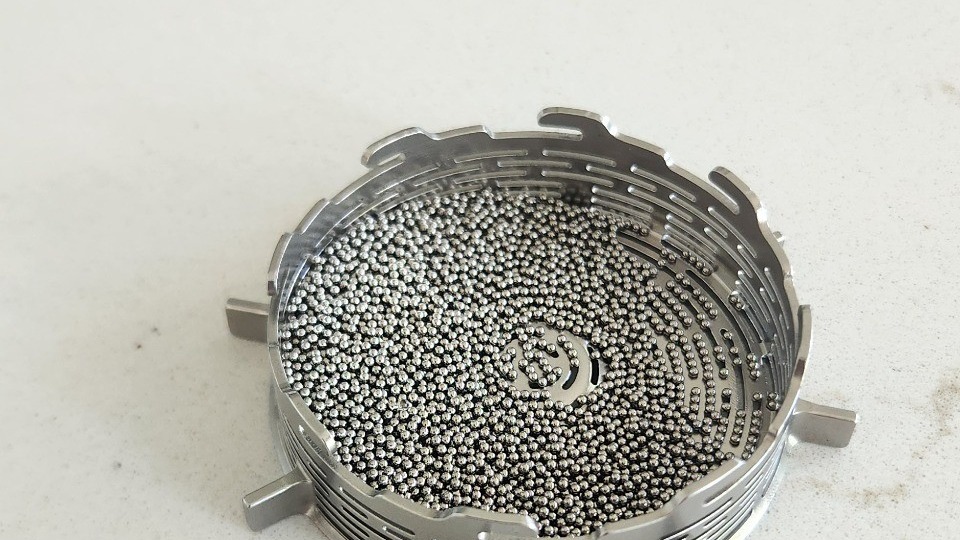
WetModule™ Nano
- 1 mm grinding media
- 0.75 mm slot size
- Best for smaller final particles
| Available Sizes / Sample Capacity | Max 60L: ~20–60 mL | Max 100L: ~35–100 mL | Max 300XL: ~140–500 mL | 3.5 gal: ~1.6–7 L × 2 | |
|---|---|---|
| Machine Compatibility | All Small, Medium, Medium+, and Large FlackTek™ Machines | |
| Construction | Stainless Steel (440C) | |
| Compatible Material Forms | Liquids · Dispersions · Suspensions · Slurries · Pastes · Gels · Emulsions · Creams | |
| Viscosity Limit | >100,000 cP | |
Additive Manufacturing & 3D Printing Learn More
Additive manufacturing (AM) increasingly relies on particle-loaded resins, suspensions, inks, and highly filled pastes whose performance depends on more than simple bulk mixing. Particle size, agglomeration state, solids loading, dispersion stability, and rheology can directly affect layer formation, nozzle reliability, curing behavior, dimensional accuracy, and the properties of the finished component.
WetModule™ systems provide high-energy wet grinding, deagglomeration, and dispersion for additive-manufacturing feedstocks ranging from low-viscosity particle suspensions to highly loaded printable pastes. The contained-media architecture eliminates loose grinding media from the finished formulation, while the recovery workflow helps return material retained around the grinding zone to the bulk sample. Micro and Nano WetModule™ configurations support both coarser particle reduction and finer dispersion requirements, with scalable configurations available from small research and development (R&D) batches through multi-liter processing.
SLA & DLP Ceramic and Metal Slurries Learn More
Stereolithography (SLA) and digital light processing (DLP) are increasingly used to manufacture ceramic and metal components from particle-loaded photocurable resins. Ceramic or metal powders are dispersed into a liquid photopolymer, printed layer by layer, and subsequently debound and sintered to produce the final inorganic component. These formulations create a difficult balance. High solids loading is desirable because it increases green density and reduces shrinkage during debinding and sintering, but increasing the particle fraction also raises viscosity and strengthens particle–particle interactions. Poor dispersion can produce agglomerates, sedimentation, nonuniform recoating, inconsistent curing, localized compositional differences, and defects in the finished part.
The WetModule™ can provide particle-size refinement, deagglomeration, dispersant incorporation, and complete slurry homogenization within the same wet-processing operation. Rather than relying on prolonged low-energy mixing to distribute highly loaded powders through a resin, contained grinding media repeatedly create energetic particle-level interactions while the bulk formulation is simultaneously homogenized. This is particularly useful for materials such as aluminum oxide, zirconium oxide, silicon dioxide, silicon carbide, aluminum nitride, and related technical ceramics, as well as particle-loaded metal photopolymers. For these systems, the WetModule™ provides a direct route from: powder + resin + dispersant + additives → homogeneous, deagglomerated printable slurry without requiring a downstream operation to manually separate loose grinding media from the formulation.
DIW & Robocasting Pastes Learn More
Direct ink writing (DIW), also commonly referred to as robocasting in ceramic applications, uses a highly filled material that is extruded through a nozzle and deposited layer by layer. DIW can process ceramics, metals, polymers, composites, carbon materials, glasses, and other functional materials, provided the feedstock possesses the required rheological behavior.
Successful DIW formulations must satisfy competing requirements. The paste needs to flow under the high shear generated inside the nozzle, but recover sufficient yield stress and structural strength immediately after deposition so that the printed filament retains its geometry and supports subsequent layers. Agglomerates can interrupt extrusion, create localized variations in rheology, produce defects, or clog the printing nozzle. These formulations are frequently extremely high in solids, making viscosity and particle mobility major processing challenges. This makes DIW one of the strongest additive-manufacturing applications for the WetModule™.
The WetModule™ is designed to maintain high-energy particle interactions across a broad viscosity range, allowing deagglomeration and homogenization to continue as the formulation moves from a conventional suspension toward a thick, highly loaded printable paste. Unlike recirculating media mills, the formulation does not have to be continuously pumped through an external grinding circuit, which becomes increasingly advantageous as viscosity and yield stress rise.
The WetModule™ can simultaneously support: particle deagglomeration → powder homogenization → dispersant distribution → binder and additive incorporation → rheology development within the same batch. This is especially valuable for alumina, zirconia, silicon carbide, silicon nitride, glass, metal, carbon-filled, and other particle-rich DIW formulations where printability depends on achieving a uniform particulate structure while maintaining the high solids loading required for the finished component.
Inkjet & Material-Jetting Suspensions Learn More
Inkjet and material-jetting additive manufacturing operate at the opposite end of the rheological spectrum from DIW. Instead of extruding a thick paste, these processes eject small droplets through fine nozzles and therefore require low-viscosity, highly stable particle dispersions with tightly controlled effective particle size. This creates a demanding dispersion problem.
Agglomerates can disrupt droplet formation, create inconsistent deposition, or completely block the printhead. Effective particle and agglomerate size must therefore remain well below the dimensions of the nozzle, while the suspended solids must remain uniformly distributed throughout the carrier liquid.
The WetModule™ can be used upstream of the printer to provide fine particle deagglomeration, particle-size refinement, and dispersion homogenization before the formulation enters the printhead. The Nano WetModule™ is particularly relevant where the objective is to eliminate fine agglomerates and produce a uniform particle population rather than perform coarse grinding. This can support ceramic, metallic, functional, and other particle-containing jetting inks where print reliability depends on maintaining a stable, finely dispersed suspension.
The contained-media design provides another practical advantage: the grinding media remain inside the WetModule™ rather than entering the finished ink. Printhead-specific filtration or final classification may still be used where required, but the separate bead-removal operation associated with conventional loose-media milling is eliminated. For material jetting, the WetModule™ is therefore primarily solving a fine-dispersion and nozzle-reliability problem rather than a high-viscosity problem.
Conductive & Functional Printing Inks Learn More
Additive manufacturing increasingly extends beyond structural components into printed electronics, sensors, heaters, antennas, energy devices, embedded circuitry, and other functional systems. These applications use particle-loaded inks containing materials such as silver, copper, carbon black, graphene, carbon nanotubes (CNTs), dielectric ceramics, magnetic materials, and other functional fillers. The properties of these inks depend strongly on dispersion quality.
Metal particles can agglomerate or settle. Carbon black forms strongly associated particulate structures. CNTs can remain as entangled bundles. Graphene-based materials can aggregate or restack. These structures can influence not only printability, but also the electrical, thermal, dielectric, magnetic, and mechanical properties of the printed feature.
The WetModule™ provides high-energy deagglomeration combined with complete bulk homogenization, allowing conductive and functional fillers to be distributed throughout the carrier phase before printing. The WetModule™ is well suited to formulations including:
- silver and copper conductive inks
- carbon-black conductive systems
- CNT and graphene inks
- conductive polymer composites
- dielectric ceramic inks
- thermally conductive particle suspensions
- magnetic and other functional particulate inks
These formulations may ultimately be deposited by DIW, inkjet, aerosol jet, or other printing technologies. The WetModule™ operates upstream of the deposition method, addressing the common requirement to create a stable, homogeneous functional dispersion before the material is delivered to the printer. Contained media and high sample recovery are particularly valuable when processing high-value functional fillers or relatively small development batches.
Particle-Reinforced & Nanofilled Photopolymer Resins Learn More
Many additive-manufacturing formulations begin with a commercial or custom photopolymer resin that is modified with solid particles to alter its processing behavior or finished properties.
Common particulate additions include fumed silica, ceramic nanoparticles, metal or metal-oxide powders, carbon black, graphene, and other nanoscale or micron-scale fillers. These materials may be incorporated to modify viscosity, cure behavior, stiffness, strength, thermal conductivity, electrical conductivity, dimensional stability, wear resistance, or other functional properties.
High-surface-area fillers can be particularly difficult to incorporate uniformly. They may form persistent agglomerates, dramatically alter rheology, and create localized compositional differences throughout the resin.
The WetModule™ extends conventional formulation capability where true particle deagglomeration or refinement is required rather than simple bulk incorporation. Contained grinding media generate localized mechanical interactions capable of breaking down particulate agglomerates while the FlackTek™ motion simultaneously distributes the filler throughout the resin. This makes it possible to prepare highly uniform particle-reinforced photopolymer systems without treating filler addition and final dispersion as separate processing operations.
The same approach can be used to modify an existing resin. A base photopolymer can be combined with fillers, rheology modifiers, photoinitiators, and other formulation components and processed toward a homogeneous printable material with tailored properties. This application is strongest for particulate and nanoscale reinforcement systems. Long fibers and other reinforcement architectures whose performance depends on preserving fiber length require a different processing approach and are not generally suited to media-assisted grinding.
Adhesives, Sealants & Filled Polymers Learn More
Adhesives, sealants, and filled polymer systems often depend on the uniform incorporation of mineral fillers, functional particles, rheology modifiers, and nanoscale additives into resin systems ranging from readily flowing liquids to non-sagging pastes. As filler loading increases, particle wetting becomes more difficult, agglomeration becomes more consequential, and viscosity can rise sharply—making effective particle-level dispersion increasingly difficult with conventional mixing alone.
The WetModule™ combines high-energy deagglomeration, particle-level dispersion, and bulk homogenization in a contained-media process. Its broad viscosity capability makes the WetModule™ particularly well suited to highly filled resins and pastes, while contained grinding media eliminate the loose-media separation step associated with conventional media milling. WetModule™ systems support formulation development from small research and development (R&D) batches through larger-volume processing using the same fundamental grinding architecture.
Filled Adhesives & Sealants Learn More
Many adhesives and sealants rely on substantial quantities of inorganic filler to control cost, mechanical performance, dimensional stability, rheology, shrinkage, thermal behavior, and application characteristics. Common fillers include calcium carbonate, silica, alumina, talc, kaolin, barium sulfate, metal powders, and other mineral or functional particulates. Their effectiveness depends not only on composition, but also on particle size, morphology, surface chemistry, concentration, and dispersion state.
The WetModule™ provides high-energy filler wetting, deagglomeration, and distribution directly within the resin system. Rather than simply moving filler clusters through the bulk formulation, the contained grinding media generate localized particle-level interactions that help break down agglomerates and distribute the resulting particles more uniformly throughout the polymer matrix.
This becomes particularly valuable as filler concentration increases. Higher loading strengthens particle–particle interactions and often raises viscosity substantially, making effective dispersion progressively more difficult. The WetModule™ can continue processing highly filled formulations without requiring the material to be diluted simply to make it easier to circulate through a conventional mill. The same approach can be applied across epoxy, polyurethane, silicone, acrylic, modified-silane, and other liquid or paste-like polymer systems whenever filler deagglomeration rather than simple blending is the limiting processing step.
High-Viscosity Sealants, Caulks & Mastics Learn More
Sealants, caulks, mastics, gap-filling adhesives, and other non-sagging formulations are intentionally designed to resist flow. Their high viscosity is useful during application, but it can create a significant manufacturing challenge: as the material becomes thicker, conventional dispersers and recirculating mills can become less effective at maintaining particle-level interactions throughout the formulation.
The WetModule™ is particularly well suited to these systems because high-energy media interactions occur directly inside the batch rather than requiring the formulation to be continuously pumped through an external grinding chamber. This allows filler agglomerates to continue encountering the grinding zone even as the bulk material becomes increasingly resistant to flow. The broad viscosity capability of the WetModule™ also allows formulators to process materials closer to their intended final concentration rather than adding excess liquid simply to make the formulation millable. This creates a strong processing option for highly filled silicone sealants, epoxy pastes, polyurethane sealants, modified-silane systems, caulks, mastics, and other formulations in which viscosity itself becomes one of the primary barriers to effective dispersion.
Rheology Modifier & Thixotrope Dispersion Learn More
Rheology modifiers are used to control sag resistance, extrusion behavior, settling, bead shape, application flow, and viscosity recovery in adhesives and sealants. Fumed silica is one of the most widely used rheology modifiers, while organoclays, bentonites, precipitated silicas, and related materials are also common. These additives present a distinctive dispersion challenge. High-surface-area particles can form persistent agglomerates and interconnected particle networks within the polymer, and their effectiveness depends strongly on how completely and consistently they are incorporated.
The WetModule™ provides controlled high-energy deagglomeration and distribution of rheology modifiers directly within the resin phase, including formulations that become substantially more viscous as the modifier network develops. For these materials, the objective is not indiscriminate particle-size reduction. Processing conditions can instead be optimized to achieve the required dispersion state while preserving the particle interactions responsible for the desired rheology. This makes the WetModule™ particularly useful for epoxy bonding pastes, silicone sealants, polyurethane systems, structural adhesives, and other formulations where rheology modifiers are responsible for anti-sag behavior, suspension stability, shear thinning, and controlled application characteristics.
Thermally Conductive Adhesives, Gap Fillers & TIMs Learn More
Thermally conductive adhesives, gap fillers, encapsulants, and thermal interface materials (TIMs) rely on high concentrations of thermally conductive particles to create efficient pathways for heat transfer through an otherwise poorly conductive polymer matrix.
Common filler systems include aluminum oxide (Al₂O₃), boron nitride (BN), aluminum nitride (AlN), silicon carbide (SiC), graphite, and hybrid combinations of particles with different sizes and morphologies. Increasing filler concentration can improve thermal transport, but it also raises viscosity and makes uniform particle dispersion progressively more difficult.
The WetModule™ addresses both sides of this challenge. High-energy media interactions help break apart ceramic-filler agglomerates, while the broad viscosity capability allows the formulation to remain highly loaded rather than being diluted simply to make processing easier. This is particularly useful for formulations containing multiple filler sizes or morphologies, where uniform distribution is required to establish efficient thermal pathways while maintaining controlled rheology.
Contained media and the WetModule™ recovery workflow provide an additional advantage when processing valuable functional fillers because the final formulation can be recovered without a separate loose-bead filtration or separation step. The result is a strong fit for thermally conductive structural adhesives, gap fillers, thermal pastes, electrically insulating heat-transfer materials, and other highly filled TIM formulations.
Electrically Conductive Adhesives & Conductive Pastes Learn More
Electrically conductive adhesives rely on conductive particulate networks rather than the polymer matrix itself to transport electrical current. Typical formulations use silver flakes or particles, copper, nickel, graphite, carbon black, carbon nanotubes (CNTs), graphene, or combinations of metallic and carbonaceous fillers.
Achieving the required conductivity depends strongly on filler distribution and particle-to-particle contact. Poorly dispersed conductive additives can remain trapped in agglomerates rather than contributing effectively to the conductive network.
The WetModule™ provides high-energy deagglomeration and homogenization of conductive fillers directly within the adhesive or resin matrix, including high-solids formulations that can become difficult to process through conventional low-viscosity dispersion equipment. This is particularly valuable for carbon black, graphene, and CNT systems, where the primary problem is often breakup of agglomerated or bundled structures rather than simple bulk mixing.
Metal-filled systems may require a different processing strategy. Silver flakes and other deliberately shaped conductive particles derive part of their performance from their morphology, so the objective may be controlled dispersion rather than maximum grinding intensity. The WetModule™ allows processing speed and cycle duration to be adjusted to optimize deagglomeration while preserving the particle structure required for conductivity. Applications include conductive epoxies, electrically conductive adhesives, carbon-filled polymer systems, conductive sealants, printed conductive pastes, and hybrid metal/carbon formulations.
Structural Adhesive Toughening & Nanofiller Dispersion Learn More
Structural adhesives are frequently modified with nanoscale or submicron fillers to improve toughness, modulus, impact performance, crack resistance, dimensional stability, and other mechanical properties.
Examples include nanosilica, nanoclay, core-shell rubber particles, carbon nanotubes (CNTs), graphene, and combinations of rigid and elastomeric modifiers. The challenge is that these materials can form persistent agglomerates, and the performance expected from a nanoscale additive can be lost when it remains distributed as much larger clusters.
The WetModule™ provides a high-energy route to deagglomerate toughening agents and distribute them throughout the resin before cure, while simultaneously homogenizing the overall formulation.
For platelet- and fiber-like nanomaterials, the objective is controlled dispersion rather than unrestricted particle destruction. Processing conditions can therefore be selected to achieve the required degree of deagglomeration while limiting unnecessary damage to functional particle morphology. This makes the WetModule™ useful for developing toughened structural epoxies, nanoclay-modified adhesives, nanosilica-reinforced systems, core-shell-rubber composites, and hybrid nanofiller formulations.
Potting Compounds, Encapsulants & Underfills Learn More
Potting compounds, electronic encapsulants, and underfill materials frequently contain large quantities of inorganic filler to control thermal expansion, thermal conductivity, dielectric properties, shrinkage, modulus, and long-term dimensional stability. Silica and alumina are particularly common, while advanced formulations can incorporate boron nitride (BN), aluminum nitride (AlN), and combinations of micro- and nanoscale fillers.
The WetModule™ provides particle-level deagglomeration and filler homogenization directly within the same high-solids resin system used in the final application. This reduces the need to create a lower-viscosity intermediate simply to achieve adequate dispersion.
The Nano WetModule™ is particularly well suited where smaller agglomerates and finer filler distributions are required, while Micro WetModule™ configurations provide higher-impact processing for larger starting agglomerates or coarser particulate systems. Because underfills and encapsulants often contain expensive engineered fillers and are produced in relatively high-value batches, the contained-media architecture and recovery cycle provide an additional practical advantage by minimizing the material retained on loose grinding media. This makes the WetModule™ well suited to filled epoxies, electronic encapsulants, potting compounds, underfill materials, dielectric encapsulation systems, and thermally enhanced packaging resins.
Flame-Retardant & Fire-Resistant Filled Polymers Learn More
Flame-retardant polymer formulations often rely on substantial quantities of mineral additives such as aluminum hydroxide, commonly referred to as alumina trihydrate (ATH; Al(OH)₃), magnesium hydroxide (Mg(OH)₂), zinc borate, and other inorganic flame-retardant or smoke-suppressing fillers.
Many mineral flame-retardant systems require high filler concentrations to achieve their intended performance. These high solids levels can substantially increase viscosity, reduce flow, and make homogeneous incorporation progressively more difficult.
The WetModule™ provides high-energy deagglomeration and distribution of flame-retardant particles directly within highly filled polymer systems. Its broad viscosity capability is particularly useful because the processing challenge becomes more severe as filler loading approaches the concentration required for the desired fire performance. For these formulations, the primary objective is generally uniform dispersion and elimination of agglomerates rather than extreme particle-size reduction. Controlled WetModule™ processing helps establish a more consistent filler distribution while maintaining the intended particulate system. Applications include flame-retardant epoxies, polyurethane compounds, sealants, filled elastomers, electrical encapsulation materials, and other polymer systems requiring high mineral loading for fire and smoke performance.
Polymer Nanocomposites & Functional Filler Dispersions Learn More
Filled polymers extend well beyond conventional adhesives and sealants. Liquid resins and polymer precursors are increasingly modified with nanoscale and functional fillers to introduce electrical, thermal, mechanical, dielectric, barrier, tribological, magnetic, or sensing properties.
Representative materials include carbon nanotubes (CNTs), graphene, graphite, nanosilica, nanoclay, metal oxides, ceramic particles, carbon black, and hybrid filler combinations. These materials are frequently supplied as agglomerated powders, and their ultimate performance depends on distributing the functional particles throughout the polymer at a scale much closer to their intrinsic particle or aggregate dimensions.
The WetModule™ provides high-energy particle deagglomeration directly within the polymer phase, avoiding the need to disperse particles in a separate low-viscosity solvent system before transferring them into the final resin.
The WetModule™ can also be used to prepare concentrated filler/resin master dispersions that are subsequently let down to the desired final concentration. This approach is particularly useful for high-surface-area nanomaterials because the initial dispersion can be performed under processing conditions selected specifically to maximize particle-level energy transfer before the concentrate is incorporated into the final formulation. This makes the WetModule™ useful for both conventional filled polymers and advanced nanocomposites where particle dispersion, agglomerate control, high viscosity, and formulation recovery determine whether the filler can deliver its intended functionality.
Aerospace & Defense Learn More
Advanced aerospace and defense materials frequently depend on ceramic powders, nanomaterials, functional fillers, abrasive particles, and highly loaded particulate systems whose performance is strongly influenced by particle size, agglomeration state, dispersion quality, and compositional uniformity.
WetModule™ systems provide high-energy wet particle-size reduction, deagglomeration, dispersion, and homogenization within a contained-media architecture. Material repeatedly moves through the grinding zone while the grinding media remain captured inside the module, eliminating the downstream media-separation step associated with conventional loose-media milling.
The combination of high-energy processing and broad viscosity capability allows WetModule™ systems to process materials ranging from fluid ceramic suspensions to highly loaded coating slurries, filled polymer systems, and paste-like feedstocks. Micro WetModule™ configurations use larger media for rapid processing of coarser starting materials, while Nano WetModule™ systems use smaller media where finer final particle distributions are required.
CMC Slurries & Infiltration Materials Learn More
Ceramic matrix composites (CMCs) are used in demanding aerospace applications where low density, high-temperature stability, and resistance to severe thermal environments are required. Silicon carbide fiber-reinforced silicon carbide (SiC/SiC) and related CMC systems are used in turbine-engine hot sections, propulsion hardware, thermal structures, and other extreme-temperature components.
Many CMC manufacturing routes rely on ceramic slurry preparation and particulate infiltration. Ceramic particles, sintering aids, and other constituents must remain uniformly dispersed while the slurry penetrates porous reinforcement structures or is incorporated into subsequent forming and densification operations.
The WetModule™ combines ceramic particle deagglomeration, particle-size conditioning, and complete slurry homogenization within the same wet-processing step. Persistent ceramic agglomerates are repeatedly exposed to the grinding zone while the complete formulation is continuously redistributed throughout the batch.
As ceramic solids loading increases, slurry viscosity can rise substantially and make conventional recirculating wet mills increasingly difficult to operate. The WetModule™ can continue generating active media interactions in concentrated systems without requiring the formulation to remain sufficiently fluid for external pumping and circulation. Applications include SiC-based matrix slurries, particulate infiltration systems, ceramic precursor suspensions, and other oxide or non-oxide CMC formulations.
Thermal & Environmental Barrier Coating Slurries Learn More
Thermal barrier coatings (TBCs) and environmental barrier coatings (EBCs) protect aerospace components from extreme temperature, oxidation, water-vapor attack, and other aggressive operating environments. These coating systems can contain finely divided oxides, silicates, rare-earth compounds, and other refractory materials whose particle size, agglomeration state, and slurry rheology influence coating uniformity and final material performance.
The WetModule™ provides high-energy ceramic deagglomeration and complete suspension homogenization, breaking down persistent particulate clusters while continuously redistributing the coating formulation through the grinding zone. Where additional particle refinement is required, media interaction can provide true particle-size reduction in addition to deagglomeration. Nano WetModule™ configurations provide increased media contact density for finer ceramic suspensions and smaller final particle distributions. Applications include rare-earth silicate EBCs, oxide bond coats, hafnium oxide (HfO₂)-containing systems, mullite-based formulations, ceramic TBC slurries, and other high-temperature protective coating systems.
Advanced Ceramic & Armor Material Slurries Learn More
Advanced ceramics are used throughout aerospace and defense where combinations of low density, hardness, wear resistance, thermal stability, chemical resistance, and ballistic performance are required. Materials such as silicon carbide (SiC), boron carbide (B₄C), alumina (Al₂O₃), nitrides, borides, and ultra-high-temperature ceramics are commonly processed as powders or concentrated slurries before forming, casting, pressing, infiltration, or sintering.
The WetModule™ provides rapid ceramic deagglomeration, particle-size refinement, and intimate distribution of multiple particulate phases and processing additives within the same slurry. This becomes increasingly important at high solids loading. Higher ceramic concentration can improve downstream forming and densification efficiency, but also increases viscosity and makes conventional wet milling progressively more difficult. The WetModule™ maintains active grinding-media interaction in highly loaded formulations while simultaneously homogenizing the complete ceramic suspension. Applications include SiC, B₄C, Al₂O₃, nitrides, borides, armor ceramics, wear-resistant ceramics, and other advanced structural or ultra-high-temperature ceramic suspensions.
Radome & RF-Transparent Ceramic Slurries Learn More
Radar radomes and radio frequency (RF) windows require materials that combine mechanical strength, thermal stability, environmental resistance, and controlled electromagnetic properties.
Silicon nitride (Si₃N₄) and related ceramics are used in high-temperature RF-transparent structures. Their manufacture requires ceramic suspensions in which particle size, particle-size distribution, agglomeration state, slurry stability, and rheology can influence forming behavior and final ceramic performance.
The WetModule™ provides controlled ceramic deagglomeration, particle-size conditioning, and suspension homogenization while allowing processing intensity to be adjusted through media configuration, machine speed, and cycle duration.
High-solids ceramic formulations can be especially difficult to process because increasing particle concentration raises viscosity while reducing particle mobility. The WetModule™ can continue processing concentrated suspensions while maintaining repeated media-particle interaction throughout the batch. Applications include Si₃N₄ and related oxide or non-oxide RF-transparent ceramic systems, including formulations containing sintering aids, dielectric modifiers, and other functional particulate components.
Nano-Reinforced Composite Dispersions Learn More
Carbon nanotubes (CNTs), graphene, boron nitride nanotubes (BNNTs), nanosilica (SiO₂), nanoceramics, and other nanoscale additives are incorporated into aerospace composites to provide combinations of mechanical reinforcement, electrical conductivity, thermal conductivity, radiation protection, sensing capability, and multifunctional behavior. These materials can be difficult to incorporate uniformly because nanoparticles readily form persistent agglomerates, while high-aspect-ratio materials such as CNTs can form entangled networks that substantially increase formulation viscosity.
The WetModule™ provides the mechanical energy required for controlled deagglomeration and uniform distribution of nanoscale fillers throughout compatible liquid or polymeric matrix systems.
Functional fillers can be dispersed into epoxy, thermoset, thermoplastic, or other compatible matrix materials before incorporation of carbon fiber, glass fiber, ceramic reinforcement, or other structural components. This allows the particle-dispersion problem to be addressed directly within the matrix phase where uniform filler distribution is required.
For morphology-sensitive nanomaterials, the objective is generally controlled deagglomeration rather than maximum particle destruction. Processing speed and cycle duration can therefore be optimized to reach the required dispersion state while preserving the functional characteristics of the nanomaterial. Applications include CNT-modified resins, graphene-reinforced composites, BNNT systems, nanoparticle-modified epoxies, SiO₂-reinforced polymers, and multifunctional aerospace composite matrices.
Thermal Management, Interface & Electrical Insulation Materials Learn More
Aerospace electronics, electrified propulsion, spacecraft systems, sensors, motors, batteries, and high-power electrical equipment require materials capable of controlling heat while maintaining the necessary electrical properties.
Thermally functional formulations can contain substantial concentrations of ceramic or carbon-based fillers such as hexagonal boron nitride (h-BN), aluminum nitride (AlN), graphite, graphene, and other thermally conductive particles. The WetModule™ provides filler deagglomeration, particle-level dispersion, and complete homogenization of highly loaded thermal-management formulations.
As filler concentration rises, thermal performance may improve while viscosity increases sharply. Agglomerated particles and incomplete filler distribution can also prevent the intended thermal or electrical properties from developing uniformly throughout the material.
The WetModule™ can continue dispersing these particulate systems as they move into high-viscosity and paste-like regimes, allowing formulations to remain highly filled while maintaining active media interaction. Applications include:
- thermal interface materials (TIMs)
- thermally conductive pastes and greases
- electrically insulating thermal composites
- filled encapsulants
- thermal potting materials
- conductive polymer systems
- h-BN and AlN dispersions
- graphite- and graphene-containing thermal formulations
EMI, RF & Microwave-Absorbing Material Dispersions Learn More
Electromagnetic interference (EMI), radio frequency (RF) attenuation, and microwave absorption are important in aircraft, spacecraft, radar systems, communications equipment, electronic warfare platforms, sensors, and other defense technologies. These materials can contain high concentrations of electrically conductive, dielectric, or magnetically active particles, including carbon nanotubes (CNTs), carbon black, graphene, carbonyl iron, ferrites, and hybrid functional fillers. The WetModule™ provides high-energy deagglomeration and uniform distribution of conductive and magnetic particulate phases throughout the carrier matrix.
This is particularly important in radar- and microwave-absorbing systems where functional-particle concentrations can become very high and formulation viscosity rises accordingly. Uniform particulate distribution is required to maintain consistent electromagnetic behavior throughout the finished material. Applications include EMI-shielding composites, RF-attenuating materials, radar-absorbing coatings, microwave-absorbing polymer systems, CNT-based shielding formulations, carbonyl-iron dispersions, ferrite-containing composites, conductive carbon systems, and multifunctional electromagnetic coatings. Where electromagnetic performance depends on maintaining an engineered particle morphology such as a flake or platelet structure, processing conditions can be selected for controlled dispersion rather than aggressive particle-size reduction.
Slurry & Paste-Based Additive Manufacturing Feedstocks Learn More
Additive manufacturing (AM) increasingly uses ceramic slurries, highly filled photopolymers, printable pastes, and particle-loaded composite feedstocks for aerospace components that cannot easily be produced through conventional manufacturing routes.
Feedstock performance depends on particle size, agglomeration state, solids loading, rheology, suspension stability, and uniform distribution of processing additives. Poor dispersion can create nonuniform flow, inconsistent deposition or curing, and defects that remain through downstream densification.
The WetModule™ provides particle deagglomeration, particle-size conditioning, additive dispersion, and feedstock homogenization during preparation of slurry- and paste-based AM formulations.
High solids loading is often desirable for ceramic and particulate AM systems because it increases material content and can reduce shrinkage during downstream processing. At the same time, increasing solids concentration raises viscosity and makes uniform dispersion more difficult. The WetModule™ can process these concentrated feedstocks while maintaining active media interaction throughout the formulation. Applications include ceramic stereolithography slurries, direct ink writing (DIW) pastes, silicon carbide (SiC)-based AM feedstocks, oxide and non-oxide ceramic suspensions, particle-filled photopolymers, and highly filled printable composite systems.
Solid Lubricant & Tribological Coating Dispersions Learn More
Aerospace and spacecraft mechanisms can operate under temperature, vacuum, contamination, or environmental conditions where conventional liquid lubricants are unsuitable.
Solid lubricants such as molybdenum disulfide (MoS₂), tungsten disulfide (WS₂), graphite, polytetrafluoroethylene (PTFE), and related materials are incorporated into bonded films, coatings, polymer systems, and other tribological formulations. The WetModule™ provides deagglomeration and uniform distribution of solid-lubricant particles throughout compatible liquid binders and coating vehicles.
Persistent particulate agglomerates in concentrated dry-film lubricant formulations can produce uneven coatings and localized differences in friction or wear performance. Repeated media interaction inside the WetModule™ breaks down these agglomerates while the complete formulation is simultaneously homogenized. Because many solid lubricants derive part of their performance from platelet-like morphology, processing is generally directed toward controlled deagglomeration and distribution rather than unnecessary destruction of the primary particle structure. Applications include MoS₂-based coatings, WS₂ dispersions, graphite-containing lubricants, PTFE-filled coatings, bonded dry-film lubricants, wear-resistant composite coatings, and specialty aerospace tribological formulations.
Optical Polishing & Lapping Slurries Learn More
High-performance aerospace optics, satellite components, telescope systems, laser assemblies, and precision structural components require tightly controlled finishing processes capable of producing extremely uniform surfaces. Polishing and lapping formulations can contain abrasive particles such as alumina (Al₂O₃), diamond, silica (SiO₂), ceria (CeO₂), and other hard materials dispersed in a liquid carrier.
Large agglomerates or nonuniform abrasive distributions can produce inconsistent material removal, scratching, localized surface defects, and poor finishing repeatability. The WetModule™ provides abrasive-particle deagglomeration, slurry homogenization, and controlled particle-size conditioning during preparation of these formulations. Applications include abrasive slurries used for silicon carbide (SiC) optics, optical ceramics, precision aerospace components, telescope structures, mirrors, and other demanding lapping and polishing operations. Where abrasive particle size is tightly specified, processing can be optimized primarily for dispersion and agglomerate removal, with intentional particle-size reduction used only where required.
Thermal Protection, Ablation-Resistant & Oxidation-Protection Slurries Learn More
Hypersonic vehicles, spacecraft re-entry systems, rocket propulsion hardware, and other extreme-temperature structures require materials capable of resisting severe heating, oxidation, erosion, and ablation. Carbon/carbon (C/C) composites, ceramic matrix composites (CMCs), and other refractory structural materials often require additional surface protection or particulate infiltration to survive these environments.
Protective formulations can contain combinations of zirconium diboride (ZrB₂), silicon carbide (SiC), hafnium diboride (HfB₂), hafnium carbide (HfC), other carbides and borides, and related ultra-high-temperature ceramic materials. The WetModule™ provides high-energy deagglomeration, particle-size conditioning, and complete homogenization of multi-component refractory slurries. These materials can be exceptionally hard and may be formulated at high solids concentration. Multiple ceramic phases must remain uniformly distributed while the slurry maintains the rheology required for coating, infiltration, spraying, or other downstream forming operations.
The contained grinding media provide repeated particle-level interaction without requiring downstream bead separation, while the broad viscosity capability allows concentrated ceramic formulations to remain processable as solids loading increases. Applications include ZrB₂-SiC systems, HfB₂- and HfC-containing ultra-high-temperature ceramic formulations, carbide and boride mixtures, oxidation-protection coatings, ablation-resistant ceramic slurries, hypersonic thermal-protection materials, particulate infiltration systems, and refractory formulations for rocket and re-entry structures.
Agrochemicals & Crop Protection Learn More
Agrochemical performance depends not only on the chemistry of the active ingredient, but also on particle size, particle-size distribution, dispersion state, suspension stability, rheology, and formulation uniformity. Many herbicides, fungicides, insecticides, seed treatments, and crop-nutrition products contain poorly soluble solid materials that must be reduced to a controlled particle size and maintained as stable dispersions.
WetModule™ systems combine high-energy wet particle-size reduction, deagglomeration, dispersion, and homogenization in a contained-media system. The grinding media remain captured inside the WetModule™ throughout processing, eliminating the downstream media-separation step associated with conventional loose-media milling. Broad viscosity capability also supports formulations ranging from fluid suspensions to concentrated, high-solids dispersions, providing a scalable platform for formulation development and production.
Active-Ingredient Wet Milling & Micronization Learn More
Many pesticide active ingredients (AIs) are crystalline solids with limited water solubility. Particle size can directly influence suspension behavior, dissolution rate, available surface area, spray distribution, and the consistency with which the active is delivered to the target.
The WetModule™ allows an AI to be wet-milled directly within a liquid carrier, combining particle-size reduction with deagglomeration and suspension homogenization. Processing the material in the liquid phase can eliminate the need to first produce a fine dry powder and subsequently redisperse it into the final formulation. This approach is particularly useful during formulation development, where particle size can be optimized alongside dispersant concentration, solids loading, carrier chemistry, and other formulation variables.
Because the grinding media remain contained inside the WetModule™, the processed material can also be recovered without a separate bead-filtration or media-separation step. This is especially useful when working with limited quantities or high-value development materials. The WetModule™ provides a versatile platform for herbicide, fungicide, insecticide, and other poorly soluble agrochemical AIs requiring controlled wet particle-size reduction.
SC Formulations Learn More
Suspension concentrates (SCs), often referred to as flowables, contain finely divided solid active ingredients suspended in a liquid continuous phase, most commonly water. Producing a stable SC requires substantially more than simply mixing a powder into liquid. The active must be wetted, deagglomerated, reduced to the required particle-size distribution, and stabilized against flocculation, settling, and hard packing.
The WetModule™ combines particle-size reduction, deagglomeration, dispersion, and bulk homogenization within the same batch process. Grinding media repeatedly interact with suspended AI particles as the formulation moves through the grinding zone, while the FlackTek™ motion continuously redistributes the bulk material. This becomes particularly valuable as AI concentration increases. Higher solids loading reduces the amount of liquid available to separate particles and can significantly increase viscosity and yield stress. Conventional circulation mills must continue pumping this increasingly difficult material through a grinding chamber and media-separation system.
The WetModule™ processes the formulation directly inside the batch cup and is designed to continue grinding and dispersing materials across a broad viscosity range. This allows formulators to work with highly concentrated SC formulations without adding excess carrier solely to make the material easier to mill. The result is a strong platform for single-active and multi-active SC formulations where particle-size control, high solids loading, dispersion quality, and efficient product recovery are critical.
OD Formulations Learn More
Oil dispersions (ODs) contain solid active ingredients dispersed in an oil-based continuous phase rather than water. They are frequently used for actives that benefit from nonaqueous processing and can also provide useful spreading, retention, or adjuvant effects during application.
Maintaining dense solid particles as a stable oil dispersion can be challenging. Agglomerates must be broken apart, newly generated surfaces must be adequately wetted and stabilized, and the formulation must resist sedimentation and hard settling while maintaining appropriate rheology.
The WetModule™ provides high-energy particle-size reduction and deagglomeration directly within the oil-based formulation. Solid AIs can be processed in the selected carrier while dispersants and other formulation components are incorporated into the developing suspension.
The broad viscosity capability of the WetModule™ is particularly useful as solids loading and rheology modifiers increase formulation thickness. Because the WetModule™ does not rely on pumping the formulation through an external media mill, concentrated and highly structured dispersions can be processed directly in the batch cup. This makes the WetModule™ particularly well suited to high-load OD formulations, water-sensitive actives, mineral and micronutrient oil dispersions, and other nonaqueous agricultural suspensions requiring controlled particle size and uniform dispersion.
SE Formulations Learn More
Suspoemulsions (SEs) combine a suspended solid phase with an emulsified liquid phase in a single formulation. They are commonly used when multiple active ingredients have substantially different physical properties—for example, when one active is an insoluble solid and another is carried within an oil phase. These systems must simultaneously control solid-particle dispersion, emulsion stability, rheology, flocculation, crystal growth, and interactions between multiple dispersed phases.
For SE development, the WetModule™ is particularly useful for preparation of the solid suspension component. The insoluble AI can be wet-milled to the required particle size and dispersion state before incorporation with the separately prepared emulsion phase. This allows the milling operation to focus specifically on the material that requires particle-size reduction while avoiding unnecessary exposure of the finished emulsion to grinding media.
The WetModule™ therefore provides an efficient route to producing fine, homogeneous, highly concentrated suspension components for multi-active SE formulations, particularly where different solubilities or physical states prevent the actives from being incorporated through a single conventional formulation route.
FS Seed Treatment Formulations Learn More
Flowable concentrates for seed treatment (FS) are specialized suspension formulations designed to deliver crop-protection active ingredients directly to seed before planting. These systems can contain solid AIs, dispersants, rheology modifiers, adhesion aids, film-forming components, pigments, and other functional additives.
Performance requirements extend beyond simple storage stability. The formulation must flow reliably through treatment equipment, coat individual seeds uniformly, adhere to the seed surface, minimize dust-off, and distribute the active consistently without excessive build-up.
The WetModule™ can perform the wet-milling and deagglomeration stage directly within the seed-treatment mill base, reducing suspended solids to a controlled particle size while simultaneously homogenizing the particulate formulation. Multi-active formulations can also be processed together when several solid components require particle-size reduction or deagglomeration. Because the media remain contained within the WetModule™, the finished mill base can be recovered without a separate bead-separation step. This is particularly useful during development of fungicidal, insecticidal, nematicidal, and combination FS formulations, where limited material quantities and complex formulations make recovery and batch efficiency important.
WDG Precursor Slurries Learn More
Water-dispersible granules (WDGs) are dry formulations that rapidly break apart in water to form a fine suspension for spray application. Depending on the manufacturing route, concentrated precursor slurries may first be prepared before spray drying or other downstream granulation processes. For these wet-process routes, the active ingredient must be adequately milled and dispersed before drying. Particle-size distribution in the precursor slurry directly influences the quality of the suspension formed when the final granule is later redispersed in water. The WetModule™ can combine AI particle-size reduction, deagglomeration, dispersant incorporation, and high-solids homogenization during preparation of the precursor slurry.
Its ability to process concentrated suspensions is particularly useful because unnecessary dilution increases the quantity of liquid that must subsequently be removed during drying. Processing at higher solids loading can reduce the amount of carrier introduced solely to make conventional milling practical. Contained media provide an additional processing advantage: once milling is complete, the precursor slurry can move directly toward drying or granulation without requiring manual bead removal or an additional media-filtration step. The WetModule™ is therefore particularly well suited to spray-dried and other wet-process WDG precursor slurries requiring controlled particle size at high solids concentration.
Mineral & Micronutrient Suspensions Learn More
Agricultural formulations frequently contain dense inorganic particles used as crop-protection actives or plant nutrients. Examples include elemental sulfur, copper compounds, zinc oxide (ZnO), manganese compounds, calcium-containing materials, and other mineral or micronutrient solids. These materials can be difficult to formulate because their high density promotes sedimentation while commercial products may require very high solids loading. Coarse particles and persistent agglomerates can further affect suspension stability, sprayability, coverage, and formulation uniformity.
The WetModule™ provides the mechanical energy required to reduce oversized particles, break mineral agglomerates, and establish a more uniform particle-size distribution within concentrated aqueous or oil-based formulations.
Broad viscosity capability is particularly valuable for dense mineral systems, which can become highly viscous even before rheology modifiers are added. The WetModule™ allows these formulations to be processed at useful solids concentrations without excessive dilution simply to accommodate a conventional recirculating mill. This makes the WetModule™ a strong fit for sulfur formulations, mineral fungicides, foliar nutrient suspensions, micronutrient concentrates, and other high-solids inorganic agricultural dispersions.
Seed Coating & Agricultural Colorant Dispersions Learn More
Pigments and colorants are widely used in seed treatments, fertilizer coatings, mulch colorants, turf products, and other agricultural formulations where visible coloration provides identification, treatment verification, product differentiation, or application control.
As with inks and coatings, pigment performance depends heavily on dispersion quality. Aggregates and agglomerates must be broken down sufficiently to develop consistent color strength, maintain formulation stability, and prevent defects such as settling, poor coating uniformity, or nozzle blockage.
The WetModule™ combines pigment deagglomeration, particle dispersion, and bulk homogenization in a contained-media system. This makes it suitable for preparing concentrated pigment master dispersions as well as incorporating colorants directly into seed-treatment and coating formulations. The WetModule™'s broad viscosity capability is particularly useful as pigment concentration, binders, and other formulation components increase resistance to flow. Applications include seed-treatment colorants, seed-coating pigment dispersions, fertilizer-coating colorants, mulch colorants, turf and grass marking products, and related agricultural pigment systems.
Fine-Particle & Nanosuspension Development Learn More
Conventional crop-protection suspensions generally use micron-scale active ingredients, but reducing particle size further can provide additional formulation and delivery opportunities for poorly soluble compounds. Depending on the chemistry, finer particles may increase available surface area, influence dissolution behavior, improve suspension uniformity, or alter deposition and biological availability.
The Nano WetModule™ is designed for finer particle-size reduction and deagglomeration, using smaller contained grinding media while retaining the high-energy FlackTek™ processing environment. This makes the Nano WetModule™ particularly useful during early-stage formulation development, where only limited quantities of a new AI may be available and multiple combinations of processing time, energy input, surfactant chemistry, and solids loading need to be evaluated. Because the grinding media remain contained, fine-particle development can be performed without the loose-bead handling and downstream media separation associated with conventional laboratory media mills. Depending on the material and processing conditions, the WetModule™ can support development programs ranging from fine micronization through nanosuspension research, providing a flexible platform for investigating increasingly small particle-size regimes while maintaining direct control over the complete formulation.
Battery Materials Learn More
WetModule™ systems are well suited to battery-material processing applications that require wet particle-size reduction, deagglomeration, dispersion, homogenization, or high-solids processing. Unlike conventional loose-media mills, the WetModule™ contains its grinding media inside the module throughout processing, allowing material to move through the grinding zone while eliminating the downstream media-separation step. High-energy FlackTek™ processing also allows the system to work across a broad viscosity range, from fluid suspensions to extremely viscous electrode pastes. WetModule™ systems are available from small research and development (R&D) volumes through multi-liter processing, supporting method development and scale-up on the same grinding architecture.
Electrode Slurry Dispersion Learn More
Lithium-ion electrode slurries combine active material, conductive additives, binder, solvent, and other functional additives into a highly loaded particulate system that must remain sufficiently homogeneous for consistent electrode coating. Agglomerated active material or conductive carbon, incomplete binder incorporation, or poor distribution of low-concentration additives can create nonuniform conductivity, coating defects, unstable rheology, localized binder-rich or binder-poor regions, and poor electrode consistency.
The WetModule™ provides high-energy deagglomeration, particle-level dispersion, and bulk mixing in the same processing step. Grinding media contained within the module repeatedly interact with solids as the slurry moves through the grinding zone, helping break down agglomerates while distributing active material, conductive additives, binder, and other formulation components throughout the slurry. This allows several formulation operations to be performed simultaneously. Binder solutions, conductive additives, active material, and functional additives can be processed together rather than requiring independent premixing and subsequent milling steps. The objective is not to grind the binder itself, but to achieve uniform incorporation of binders and functional additives while simultaneously deagglomerating and dispersing the particulate phases.
This becomes particularly valuable as solids loading increases. Higher-solids electrode formulations can become extremely viscous and increasingly difficult to circulate through conventional media mills. The WetModule™ is designed specifically to continue grinding and dispersing highly viscous materials, allowing formulators to work at higher solids concentrations without first diluting the slurry simply to make it processable. The WetModule™ can process materials ranging from low-viscosity liquids through very thick pastes, including systems exceeding approximately 100,000 centipoise (cP) in appropriate applications. The result is a particularly strong fit for lithium nickel manganese cobalt oxide (NMC), lithium nickel cobalt aluminum oxide (NCA), lithium iron phosphate (LFP), lithium manganese iron phosphate (LMFP), graphite, silicon-containing, and other electrode slurries where deagglomeration, dispersion quality, binder and additive uniformity, and high-solids processing are critical.
Carbon Black Dispersion Learn More
Conductive carbon is one of the most demanding components to disperse in an electrode formulation. Carbon black forms strongly associated agglomerates that must be broken apart and distributed throughout the electrode so that relatively small quantities of conductive additive can create an effective electronic pathway.
The WetModule™ is particularly well suited to this problem because it combines intense media interaction with simultaneous bulk movement of the formulation. Rather than simply stirring carbon agglomerates through the slurry, the grinding media provide localized mechanical energy capable of breaking down agglomerated structures and distributing the carbon more uniformly.
This is especially useful for carbon-black master dispersions and high-solids electrode formulations, where viscosity can rapidly increase as the conductive network develops. The WetModule™'s broad viscosity capability allows the dispersion process to continue even as the system becomes substantially thicker.
Contained media are another important advantage. Carbon dispersions readily coat conventional loose beads and other process surfaces. With the WetModule™, the media remain captured inside the cage, and the subsequent recovery cycle removes residual material from the module and returns it to the bulk sample rather than requiring manual bead separation.
CNT & Graphene Dispersion Learn More
Carbon nanotubes (CNTs), graphene, and other high-aspect-ratio conductive additives can provide extremely efficient conductive networks, but only when they are adequately dispersed. CNTs in particular tend to form entangled bundles that are difficult to separate through conventional low-energy mixing.
The WetModule™ provides the combination of high mechanical energy, rapid batch processing, and strong bulk homogenization needed to break apart conductive-additive agglomerates and distribute them through the formulation.
The advantage here is not simply maximum energy; it is the ability to reach a target dispersion rapidly. Because FlackTek™ systems impart high acceleration to the contained grinding media, effective deagglomeration can be achieved using comparatively short processing cycles rather than requiring prolonged conventional milling.
The WetModule™ is particularly well suited to CNT master dispersions, graphene and graphene-derivative dispersions, carbon-black/CNT hybrid systems, and conductive-additive packages incorporated directly into electrode slurries. For these materials, the process objective is typically controlled deagglomeration and distribution rather than indiscriminate particle destruction, making processing time and energy input useful optimization parameters.
High-Solids and High-Viscosity Electrode Pastes Learn More
High-solids battery formulations can reduce solvent usage and downstream drying requirements, but increasing solids content creates a major processing challenge: viscosity rises rapidly and particle mobility falls.
Many traditional wet-processing technologies become progressively more difficult to operate as the material becomes thicker. Recirculating mills must still move the formulation through pumps, piping, screens, and grinding chambers, while lower-energy mixers can lose the ability to produce effective particle-level deagglomeration. This is one of the most differentiated applications for the WetModule™.
The FlackTek™ platform provides sufficiently high acceleration to keep the media and material actively interacting even in highly viscous systems. The WetModule™ is designed to process high-viscosity dispersions and materials above approximately 100,000 centipoise (cP) in appropriate applications. This allows formulators to approach the problem from the opposite direction: instead of adding solvent so that the material can be processed, process the material at the concentration actually desired. That makes the WetModule™ particularly attractive for next-generation high-solids electrode development, concentrated conductive pastes, and formulations approaching paste-like rheology.
LFP & LMFP Wet Milling Learn More
Lithium iron phosphate (LFP) and lithium manganese iron phosphate (LMFP) frequently require tight control over particle size, particle-size distribution, and agglomeration state.
The WetModule™ can be used for both true particle-size reduction and deagglomeration of LFP and LMFP materials in a liquid phase. Coarser materials can first be processed using Micro WetModule™ configurations with 3 mm media, while Nano WetModule™ systems use 1 mm media where finer particle refinement is required. Micro configurations are designed for larger starting particles, while Nano configurations are suited to smaller final particle sizes.
An important advantage of the WetModule™ is that grinding performance is not determined by media diameter alone. Smaller conventional beads provide more contact points, but each bead has less mass and therefore less available momentum per collision. The high acceleration generated by the FlackTek™ system allows the WetModule™ to use comparatively larger media while still producing highly energetic and effective grinding events.
For LFP and LMFP, this creates a useful processing range spanning: agglomerate breakup → micron-scale refinement → submicron particle-size development → final slurry dispersion. The same platform can therefore participate at multiple stages rather than being limited to a single milling operation.
Silicon & SiOₓ Particle-Size Reduction Learn More
Silicon-based anode materials often require aggressive particle-size control because electrochemical behavior, mechanical stability, and composite structure are strongly influenced by silicon particle dimensions and agglomeration state.
The WetModule™ provides a high-energy wet-milling environment capable of both reducing silicon or silicon oxide (SiOₓ) particle size and preventing freshly processed particles from remaining in large agglomerates. Wet processing also makes it possible to perform size reduction directly within a carrier liquid or formulation rather than producing a fine dry powder that subsequently has to be redispersed.
The Nano WetModule™ is particularly appropriate where the objective moves from coarse reduction toward finer particle refinement, while the high-energy FlackTek™ motion helps maintain effective breakage despite the relatively small particle dimensions. This makes the WetModule™ a strong development platform for silicon, SiOₓ, silicon-rich alloys, silicon-containing composites, and other high-capacity anode materials.
Silicon–Graphite and Silicon–Carbon Composite Processing Learn More
Many commercial and developmental silicon anodes are not pure silicon systems. Silicon or silicon oxide (SiOₓ) is combined with graphite and conductive carbon to create a composite electrode material. That creates a particularly good application for the WetModule™ because several processing objectives can occur simultaneously: silicon particle refinement, deagglomeration, graphite/silicon homogenization, conductive-carbon dispersion, and formation of intimate particle-to-particle contact. Rather than grinding silicon separately, recovering it, and then performing additional mixing and dispersion steps, the WetModule™ can potentially combine these functions inside a single wet-processing operation.
The broad viscosity capability is again important because silicon–graphite formulations can become highly loaded and paste-like. The WetModule™ allows the composite to be processed at high solids concentration while the contained grinding media continue generating particle-level interactions. For research and development (R&D) groups developing silicon-containing anodes, that combination of grinding + dispersion + composite formation is considerably more useful than simple particle-size reduction alone.
Cathode Precursor Wet Grinding and Homogenization Learn More
Cathode synthesis often begins with multiple particulate precursors that must be uniformly distributed before thermal processing. Particle size, agglomeration state, and compositional uniformity all influence the effectiveness of subsequent calcination or solid-state reaction. The WetModule™ can simultaneously provide particle-size reduction, deagglomeration, intimate mixing, and suspension homogenization. This allows lithium-, iron-, phosphate-, manganese-, nickel-, cobalt-, or other precursor components to be processed together rather than being independently milled and subsequently blended.
The high-energy grinding environment can shorten the distance between precursor phases and create a more homogeneous feed entering subsequent synthesis steps. Because the WetModule™ performs both grinding and mixing at the same time, processing operations that traditionally require separate milling and blending equipment can potentially be consolidated into a single batch step.
Post-Calcination Cathode Deagglomeration Learn More
Calcined cathode materials can contain clusters or agglomerates that need to be broken apart before downstream formulation. In these applications, the objective is often not aggressive primary-particle grinding but controlled removal of unwanted agglomerates.
The WetModule™ provides a useful approach because grinding intensity is highly controllable through processing speed and cycle duration. Short processing cycles can supply sufficient energy to separate agglomerated structures without requiring the long residence times associated with many conventional milling systems.
Wet processing also allows the particles to remain suspended during deagglomeration, improving bulk uniformity and reducing the likelihood that separated particles simply remain as dry clusters. For engineered cathode powders, the WetModule™ can be used as a rapid conditioning step between calcination and slurry formulation, with processing conditions selected specifically for deagglomeration rather than maximum particle-size reduction.
Ceramic Separator-Coating Dispersions Learn More
Ceramic-coated separators commonly use finely divided inorganic particles such as alumina or boehmite suspended in a liquid formulation. Coating performance depends strongly on maintaining a uniform dispersion and eliminating ceramic agglomerates that can create coating defects or local thickness variation. This is fundamentally a ceramic wet-dispersion problem, making it highly compatible with the WetModule™.
The contained media provide the mechanical energy required to deagglomerate ceramic particles while the FlackTek™ motion homogenizes the complete coating formulation. Nano WetModule™ configurations are particularly appropriate where fine dispersions are required.
As solids loading increases, separator-coating formulations can also become significantly more viscous. The WetModule™ retains the same advantage seen in electrode slurries: the system does not depend on continuously pumping the material through an external milling circuit and can therefore continue processing formulations well into high-viscosity ranges. This makes alumina, boehmite, and related ceramic separator coatings a strong non-electrode application for the WetModule™ within battery manufacturing.
Cathode–Carbon Composite and Carbon-Coating Preparation Learn More
Many cathode systems benefit from intimate contact between the active material and a conductive carbon phase. The manufacturing objective can therefore extend beyond simple blending: carbon needs to be distributed at or around the active-material particle scale. The WetModule™ can combine active-material refinement, carbon deagglomeration, and intimate composite mixing in one processing step. This is particularly relevant to lithium iron phosphate (LFP) and other comparatively low-conductivity materials where carbon distribution strongly influences the electronic pathway through the finished electrode. Instead of treating carbon dispersion and cathode processing as independent operations, the WetModule™ allows them to be approached as a single wet-composite-processing problem.
The contained-media architecture is also advantageous when processing valuable materials because no additional filtration or bead-separation operation is required before the resulting composite dispersion can be recovered. The WetModule™ recovery workflow spins residual material from the cage and media back into the main batch.
Lithium–Sulfur and Sulfur–Carbon Composite Processing Learn More
Lithium–sulfur cathodes require intimate association between electrochemically active sulfur species and conductive carbon because sulfur-containing phases have intrinsically poor electronic conductivity.
The WetModule™ can be used to produce finely dispersed sulfur–carbon or lithium sulfide (Li₂S)–carbon composites, combining particle-size reduction with carbon deagglomeration and intimate solid–solid mixing. The high-energy media interactions improve contact between the particulate phases while simultaneous bulk motion distributes the composite throughout the liquid phase. This creates a useful development route for sulfur/carbon, Li₂S/carbon, and related formulations in which the desired outcome is not simply smaller particles but a more homogeneous conductive composite structure. Because these are frequently research-stage formulations produced in relatively small quantities, the WetModule™'s ability to process research and development (R&D)-scale batches while retaining the same fundamental grinding architecture used at larger volumes is particularly attractive.
Solid-State Battery Composite Slurries Learn More
Solid-state battery development increasingly requires extremely intimate mixing between cathode active material, solid electrolyte, conductive carbon, and—in slurry-based manufacturing routes—an appropriate liquid-processing system. Unlike conventional lithium-ion electrodes, these materials depend heavily on solid–solid interfacial contact, making dispersion quality especially important.
The WetModule™ provides high-energy deagglomeration and composite mixing capable of distributing multiple particulate phases throughout a single formulation. This can be useful for wet or liquid-assisted preparation of composite cathodes, solid-electrolyte dispersions, and other solid-state battery formulations where uniform particle contact is difficult to achieve through conventional mixing alone.
Because solid-state processing routes vary significantly by electrolyte chemistry, the exact formulation and processing conditions will vary. Where the formulation is compatible with wet processing, however, the fundamental mechanism of the WetModule™ is a strong fit.
Black Mass and Battery-Recycling Slurries Learn More
Battery recycling creates heterogeneous particulate mixtures containing cathode material, graphite, metallic phases, and other cell components. Following initial crushing and liberation, further wet grinding can be used to reduce particle size, deagglomerate material, homogenize black mass, and increase accessible surface area before downstream separation or extraction. The WetModule™ offers a compact approach to wet black-mass refinement and mechanical activation, particularly at laboratory and process-development scales.
The high-energy media environment can rapidly generate fresh particle surfaces and reduce large agglomerates, while simultaneous mixing maintains a uniform suspension. This can be particularly useful when evaluating downstream hydrometallurgical or other extraction processes because the WetModule™ can produce a consistent, finely processed slurry without a subsequent loose-media separation step. The application is best described as black-mass wet grinding, slurry homogenization, and mechanical activation, with the WetModule™ serving as a processing step within the broader recycling workflow.
Catalysts, Fuel Cells & Electrolyzers Learn More
Catalyst and electrochemical-material performance depends not only on chemical composition, but also on particle size, agglomeration state, phase distribution, slurry rheology, and the microscopic structure created during coating or deposition. Effective processing is therefore critical when preparing catalyst washcoats, supported catalysts, electrocatalyst inks, ceramic electrode slurries, and other catalyst-containing formulations.
WetModule™ systems provide high-energy wet particle-size reduction, deagglomeration, dispersion, and homogenization in a contained-media format. Grinding media remain captured inside the WetModule™, eliminating the downstream bead-separation step associated with conventional loose-media milling. The broad viscosity capability of the WetModule™ also supports formulations ranging from fluid catalyst suspensions to highly concentrated slurries and pastes.
The integrated recovery workflow is particularly valuable when processing high-value catalyst materials, allowing residual formulation to be recovered from the media and grinding cage rather than remaining trapped in loose grinding beads.
Catalyst Washcoat & Monolith-Coating Slurries Learn More
Catalytic converters, industrial reactors, and other structured catalysts commonly use thin catalyst-containing washcoats deposited onto ceramic or metallic substrates. These formulations may contain alumina, silica, ceria–zirconia, zeolites, binders, and catalytically active components suspended in a liquid carrier.
Particle size and slurry structure influence washcoat uniformity, loading, thickness, substrate penetration, adhesion, and coating stability. Oversized particles and agglomerates can interfere with coating quality, while poorly controlled rheology can make it difficult to produce a consistent catalyst layer.
The WetModule™ can perform particle-size reduction, deagglomeration, and slurry homogenization in the same batch process, allowing catalyst-support materials and other washcoat components to be conditioned directly within the coating formulation. This approach is applicable to washcoats used in:
- three-way catalysts (TWCs)
- diesel oxidation catalysts (DOCs)
- selective catalytic reduction (SCR) catalysts
- catalytic particulate filters
- reforming catalysts
- other coated monolith and structured-reactor systems
The WetModule™ becomes particularly useful as solids loading and viscosity increase. Because the material is processed directly in the batch vessel, the formulation does not need to be continuously pumped through an external milling circuit. Contained grinding media and the recovery workflow also simplify processing when valuable catalyst components are present.
Heterogeneous Catalyst & Catalyst-Support Wet Milling Learn More
Many heterogeneous catalysts consist of an active catalytic phase distributed on a high-surface-area support such as alumina, silica, titania, ceria–zirconia, carbon, or another porous inorganic material. Wet processing may be required to reduce support particle size, break apart agglomerates, homogenize multiple inorganic phases, distribute active components, or prepare a uniform slurry for coating, impregnation, drying, or spray processing.
The WetModule™ combines these operations in a single high-energy wet-processing step. Support particles can be refined and deagglomerated while catalyst precursors or additional solid phases are simultaneously distributed throughout the liquid formulation. Applications include:
- supported metal catalysts
- supported metal-oxide catalysts
- mixed-oxide catalysts
- catalyst precursor slurries
- catalyst carriers prepared for impregnation
- spray-drying feeds
- catalyst coating formulations
WetModule™ systems are particularly useful in catalyst development, where multiple support chemistries, active phases, particle sizes, and formulation conditions may need to be evaluated before scale-up.
Zeolite & Molecular-Sieve Catalyst Processing Learn More
Zeolites and related molecular-sieve materials are widely used in catalysis because their crystalline microporous structures provide high surface area, shape selectivity, ion-exchange behavior, and chemically tunable active sites. Their processing requires careful control. External particle size or agglomerate size may need to be reduced while preserving the underlying crystalline structure responsible for catalytic function. The WetModule™ provides a controlled route to zeolite particle-size refinement, deagglomeration, slurry homogenization, and preparation of coating-ready dispersions.
High-energy processing allows useful particle-size reduction to be achieved over comparatively short processing cycles, while speed and processing time can be adjusted according to the required endpoint. This is particularly valuable when the objective is controlled refinement rather than prolonged indiscriminate grinding. Relevant applications include:
- selective catalytic reduction (SCR) catalyst formulations
- hydrocracking catalysts
- hydroisomerization catalysts
- catalytic monolith coatings
- molecular-sieve catalyst suspensions
- zeolite-containing heterogeneous catalysts
PEM Fuel Cell Catalyst Inks Learn More
Proton exchange membrane (PEM) fuel cells commonly use catalyst inks containing electrocatalyst particles, an ion-conducting polymer, and a liquid solvent system. Platinum supported on carbon (Pt/C), for example, must be dispersed together with ionomer to create a catalyst layer with controlled microscopic structure. Agglomeration state influences ink rheology, coating uniformity, catalyst distribution, pore structure, and utilization of the active material.
The WetModule™ provides controlled high-energy deagglomeration and homogenization of catalyst inks, helping break down catalyst-support aggregates while uniformly distributing solids and ionomer throughout the formulation. Applications include catalyst inks for:
- PEM fuel cells
- catalyst-coated membranes (CCMs)
- catalyst-coated substrates
- gas diffusion electrodes (GDEs)
- related low-temperature fuel-cell architectures
For these formulations, the objective is typically controlled dispersion rather than maximum particle destruction. Processing speed and cycle duration can therefore be adjusted to achieve the required aggregate structure while avoiding unnecessary extended treatment. The contained-media architecture is also particularly useful when working with platinum-group-metal catalysts, where minimizing material retained on processing equipment can be economically important.
PEM Water Electrolyzer Catalyst Inks Learn More
Proton exchange membrane water electrolyzers (PEMWEs) rely on highly active electrocatalyst layers, particularly iridium oxide (IrO₂) and related iridium-containing materials on the oxygen-evolution side of the cell.
Catalyst agglomeration can reduce accessible surface area, destabilize the ink, and create nonuniform catalyst layers. Effective dispersion is therefore important for controlling particle distribution, ink stability, coating structure, and utilization of the active catalyst.
The WetModule™ provides a high-energy processing route for IrO₂ and related catalyst deagglomeration, particle refinement, slurry homogenization, and preparation of coating-ready catalyst inks. Because catalyst and ionomer do not necessarily require the same amount of mechanical treatment, the WetModule™ also supports staged formulation workflows such as: catalyst deagglomeration → particle refinement → ionomer addition → final ink homogenization This allows the high-energy grinding step to be focused on the particulate catalyst before more shear-sensitive formulation components are introduced. Contained grinding media and the recovery workflow are particularly advantageous when processing iridium-containing formulations because of the high value of the active material.
AEM & Alkaline Electrolyzer Catalyst Dispersions Learn More
Anion exchange membrane (AEM) and alkaline electrolyzers can use catalyst systems based on nickel, iron, cobalt, layered double hydroxides, supported catalysts, and other non-platinum-group-metal electrocatalysts. These materials often form micron-scale clusters or agglomerates that reduce accessible surface area and make it difficult to produce uniform electrode coatings.
The WetModule™ provides rapid catalyst-cluster reduction, deagglomeration, slurry homogenization, and uniform catalyst/binder distribution within alkaline and AEM electrode formulations. Relevant catalyst systems include:
- nickel–iron catalysts
- nickel- and cobalt-based oxides
- nickel- and cobalt-based hydroxides
- layered double hydroxides
- supported electrocatalysts
- catalyst-coated porous transport electrodes
As catalyst loading increases, these formulations can become increasingly concentrated and viscous. The WetModule™ maintains high-energy media interaction across a broad viscosity range, allowing particle-level processing to continue in formulations that may become difficult to handle with lower-energy dispersion methods.
CO₂ Electrolyzer & GDE Catalyst Inks Learn More
Carbon dioxide (CO₂) electrolysis frequently uses a gas diffusion electrode (GDE) containing a finely distributed catalyst layer formed from metal or supported catalyst particles, binder or ionomer, and a liquid solvent system. Catalysts may include copper, silver, tin, bismuth, and other materials selected according to the desired CO₂ reduction pathway.
The dispersion state of the catalyst ink influences aggregate size, catalyst-layer uniformity, porosity, hydrophobicity, capillary behavior, reactant transport, and electrochemical performance.
The WetModule™ provides high-energy deagglomeration and controlled homogenization of catalyst particles, conductive components, binder or ionomer, and solvent before electrode deposition. The resulting dispersions can be used in coating processes including:
- spray coating
- slot-die coating
- blade coating
- catalyst-coated gas diffusion layers
- other electrode-deposition processes
When nanoscale particle structure or morphology contributes directly to catalytic activity, processing conditions can be selected to emphasize deagglomeration and uniform distribution rather than unrestricted primary-particle grinding.
SOFC & SOEC Ceramic Electrode Slurries Learn More
Solid oxide fuel cells (SOFCs) and solid oxide electrolysis cells (SOECs) use ceramic and ceramic–metal composite materials to form electrodes and electrolytes.
Common material systems include nickel oxide/yttria-stabilized zirconia (NiO/YSZ), lanthanum strontium manganite/yttria-stabilized zirconia (LSM/YSZ), lanthanum strontium cobalt ferrite (LSCF), gadolinium-doped ceria (GDC), and related functional oxides. These materials are commonly processed as wet slurries or pastes before:
- tape casting
- screen printing
- dip coating
- spray deposition
- additive manufacturing
- other ceramic-forming processes
Particle-size distribution, agglomeration state, and phase homogeneity can influence coating quality, sintering behavior, porosity, interfacial contact, and final electrochemical structure.
The WetModule™ is particularly well suited to these formulations because it combines ceramic particle-size reduction, deagglomeration, multi-phase homogenization, and paste dispersion in the same processing platform. Its broad viscosity capability also allows processing to continue as formulations move from low-viscosity ceramic suspensions toward concentrated printable slurries and pastes.
Photocatalyst Dispersions Learn More
Photocatalytic materials such as titanium dioxide (TiO₂) are used in self-cleaning surfaces, antibacterial coatings, air purification, water treatment, and other light-activated catalytic systems. Their performance depends strongly on available surface area and uniform distribution. Agglomeration can reduce accessible catalytic surface and make it difficult to produce homogeneous coatings or stable suspensions.
The WetModule™ provides particle-size refinement, deagglomeration, and uniform photocatalyst dispersion directly within the final formulation or within a concentrated master dispersion. This makes the WetModule™ suitable for processing TiO₂ and related photocatalytic materials used in:
- functional coatings
- self-cleaning surfaces
- antibacterial materials
- photocatalytic water-treatment formulations
- air-purification coatings
- specialty catalyst suspensions
The broad viscosity capability of the WetModule™ is particularly valuable when photocatalysts are incorporated into concentrated coating systems, allowing deagglomeration to continue even as solids loading and formulation viscosity increase.
Ceramics & Ceramic Slurries Learn More
Ceramic processing places demanding requirements on particle size, dispersion quality, solids loading, and slurry rheology. Agglomerates, nonuniform particle distributions, or inadequate mixing can carry directly into forming, drying, firing, coating, or printing operations and ultimately affect density, surface quality, dimensional stability, and final material performance.
WetModule™ systems combine high-energy wet grinding, deagglomeration, dispersion, and bulk homogenization in a contained-media system. The WetModule™ is designed for wet materials ranging from fluid suspensions through highly loaded pastes, while its contained grinding media eliminate the loose-media separation step normally associated with conventional media milling. Micro and Nano WetModule™ configurations provide different media sizes for processing coarser starting materials or pursuing finer particle refinement, and the platform supports development from small research batches through larger-scale processing.
Ceramic Slurry Dispersion & High-Solids Processing Learn More
Ceramic slurries are often formulated at high solids loading to increase green density, reduce drying requirements, limit shrinkage, and improve downstream manufacturing efficiency. As solids concentration increases, however, particle–particle interactions become stronger, viscosity rises, and complete deagglomeration becomes progressively more difficult.
Stable ceramic processing therefore depends on more than simply suspending powder in a liquid. Agglomerates must be broken apart, individual particles must be distributed throughout the continuous phase, and dispersants, binders, plasticizers, and other formulation components must be incorporated uniformly.
The WetModule™ combines particle-level deagglomeration with simultaneous bulk homogenization, allowing ceramic powders and formulation additives to be processed together rather than relying exclusively on lower-energy mixing. Its broad viscosity capability becomes particularly valuable as ceramic loading increases and conventional circulation-based milling becomes more difficult. Because the grinding media remain contained inside the WetModule™, highly loaded ceramic formulations can also be recovered without screening loose beads from the finished slurry. This simplifies development and processing of concentrated ceramic suspensions where both dispersion quality and material recovery are important.
Advanced Ceramic Powder Wet Milling Learn More
Advanced ceramics frequently require controlled particle-size reduction before forming or formulation. Common materials include aluminum oxide (Al₂O₃), zirconium oxide (ZrO₂), silicon carbide (SiC), silicon nitride (Si₃N₄), aluminum nitride (AlN), boron carbide (B₄C), fused silica, and related oxide and non-oxide ceramics.
Particle size influences powder packing, sintering behavior, surface area, microstructural development, and final mechanical properties. Wet milling can therefore be used both to reduce primary particle size and to break down larger agglomerates that would otherwise remain in the processed material.
The WetModule™ provides a high-energy wet-milling environment in which particle reduction and suspension homogenization occur simultaneously. Micro WetModule™ configurations use 3 mm media for stronger interactions with coarser starting particles, while Nano WetModule™ systems use 1 mm media for finer particle refinement. This allows the same fundamental processing platform to move from coarse ceramic-powder refinement through deagglomeration and final slurry preparation rather than requiring completely separate grinding and mixing operations.
Tape-Casting Slurries Learn More
Tape casting relies on a carefully controlled ceramic slurry containing powder, liquid carrier, dispersant, binder, plasticizer, and other formulation components. The slurry must remain homogeneous while also developing the rheology required to form a thin, uniform green tape.
Tape casting is used extensively with materials such as aluminum oxide (Al₂O₃), zirconium oxide (ZrO₂), silicon carbide (SiC), aluminum nitride (AlN), glass-ceramics, and multilayer electronic ceramics. Slurry dispersion is particularly important because agglomerates or compositional variation can produce surface defects, local density differences, nonuniform shrinkage, and defects during subsequent lamination or sintering.
The WetModule™ provides deagglomeration, particle refinement, and formulation homogenization within the same processing step. Ceramic powder can be dispersed in the liquid phase together with the appropriate dispersant before binders and other organic components are incorporated, allowing the processing sequence to be matched to the specific formulation.
This is particularly useful for high-solids tape-casting systems where maintaining fine particle dispersion without excessive dilution is critical. The contained-media architecture also eliminates the need to separate loose milling balls from the finished casting slurry before downstream processing.
Slip Casting, Pressure Casting & Gelcasting Slurries Learn More
Slip casting, pressure casting, and gelcasting depend on concentrated ceramic suspensions that can flow sufficiently during forming while maintaining a uniform distribution of ceramic solids. Materials such as aluminum oxide (Al₂O₃), zirconium oxide (ZrO₂), and alumina–zirconia composites are often processed at high solids concentrations where agglomeration, dispersant performance, and slurry rheology can strongly influence green density and final ceramic quality.
The WetModule™ provides a direct way to process these highly loaded suspensions while simultaneously deagglomerating powder, distributing multiple ceramic phases, and homogenizing formulation additives. High-energy processing can accelerate development of a uniform suspension compared with prolonged conventional milling, while processing speed and cycle duration can be adjusted to target the required degree of deagglomeration without unnecessarily driving additional particle-size reduction. The result is a flexible approach for preparing casting slurries that require high solids loading, reproducible rheology, and uniform particle distribution before forming.
Spray-Drying Feedstock Slurries Learn More
Spray drying is widely used to convert fine ceramic suspensions into free-flowing granules for uniaxial pressing, isostatic pressing, thermal spraying, and other powder-forming operations.
The characteristics of the spray-dried granules depend heavily on the slurry entering the atomizer. Agglomeration, inadequate phase distribution, or unstable rheology can carry through into granule density, morphology, compaction behavior, and ultimately the microstructure of the fired ceramic. The WetModule™ can prepare spray-drying feedstocks through simultaneous wet milling, deagglomeration, and suspension homogenization before atomization.
This is particularly useful for composite ceramic feedstocks, where maintaining an even distribution of two or more solid phases can be just as important as controlling overall particle size. The WetModule™'s high-viscosity capability also supports concentrated spray-drying feedstocks without requiring unnecessary dilution simply to make the formulation easier to process.
Ceramic Additive Manufacturing Slurries & Pastes Learn More
Ceramic additive manufacturing places unusually demanding requirements on slurry preparation. Processes such as stereolithography (SLA), digital light processing (DLP), and direct ink writing (DIW) require ceramic particles to be highly dispersed while maintaining the specific viscosity, yield stress, or curing behavior required by the printing process.
Common materials include aluminum oxide (Al₂O₃), zirconium oxide (ZrO₂), silicon carbide (SiC), silicon nitride (Si₃N₄), hydroxyapatite, and other technical ceramics. Highly loaded formulations can become extremely viscous, while persistent agglomerates can contribute to nozzle blockage, poor print resolution, nonuniform green density, and defects during subsequent debinding or sintering.
The WetModule™ is particularly well suited to these formulations because it combines high-energy deagglomeration with the ability to process highly viscous, high-solids materials. Ceramic powder can be refined and dispersed directly into the liquid or resin system, reducing the need to prepare a separately milled powder and then redisperse it into a printing vehicle.
For extrusion-based ceramic pastes, the broad viscosity capability of the WetModule™ provides an additional advantage as formulations move from conventional slurries toward concentrated, shear-thinning printable pastes.
Electroceramic, MLCC & LTCC Slurries Learn More
Electronic ceramics require extremely uniform particle distributions because variations at the micron or submicron scale can directly affect dielectric, piezoelectric, magnetic, or electrical performance. Applications include barium titanate (BaTiO₃) dielectrics for multilayer ceramic capacitors (MLCCs), lead zirconate titanate (PZT) and related piezoelectric ceramics, ferrites, and glass-ceramic formulations used in low-temperature co-fired ceramics (LTCCs).
Fine dispersion becomes increasingly important as dielectric layers become thinner and ceramic particle sizes decrease. In many of these applications, the desired objective is not aggressive comminution but controlled deagglomeration while preserving an engineered particle morphology.
The WetModule™ provides high-energy processing with controllable speed and cycle duration, allowing the process to be optimized around the required balance between particle refinement and morphology preservation. Contained media also eliminate the need for a separate bead-removal operation before the finished electroceramic slurry proceeds to casting, coating, or printing.
Ceramic Composite & Multiphase Slurries Learn More
Many advanced ceramics combine two or more particulate phases to achieve properties that cannot be obtained from a single ceramic composition. Examples include zirconia-toughened alumina (ZTA), alumina-toughened zirconia (ATZ), ceramic–metal systems, oxide–nonoxide composites, functionally graded materials, and ceramics containing secondary reinforcing or functional phases.
For these materials, the processing challenge extends beyond particle-size reduction. Each constituent must remain uniformly distributed throughout the slurry so that phase segregation or localized agglomerates do not carry into the green body and final microstructure.
The WetModule™ can simultaneously provide particle refinement, deagglomeration, and intimate multiphase homogenization. Rather than milling each ceramic component independently and performing a separate blending step, compatible constituents can be processed together within the liquid phase. This combination is particularly valuable during research and development (R&D) of new ceramic compositions, where rapid formulation iteration, uniform phase distribution, and recovery of relatively small quantities of high-value material can all be important.
Glazes, Frits & Ceramic Pigment Dispersions Learn More
Ceramic glazes, glass frits, opacifiers, and pigments rely on controlled particle size and uniform dispersion to achieve consistent color, opacity, surface finish, melting behavior, and fired appearance.
Typical raw materials include feldspar, quartz, zircon, glass frit, metal-oxide pigments, and other mineral or ceramic phases. Depending on the formulation, processing may require both true comminution of relatively coarse constituents and deagglomeration of already fine pigments or opacifiers. The WetModule™ can combine comminution of coarse frit or mineral components with deagglomeration and homogenization of the final glaze or pigment suspension.
This is particularly useful during formulation development, where multiple pigment, frit, and mineral combinations may need to be evaluated rapidly. Contained grinding media and the recovery workflow simplify product recovery while eliminating the loose-media separation step associated with conventional batch milling.
Abrasive & Polishing Slurries Learn More
Fine ceramic powders are widely used as abrasive and polishing materials where particle size, agglomeration state, and dispersion uniformity directly affect material-removal behavior and final surface quality. Common materials include aluminum oxide (Al₂O₃), cerium oxide (CeO₂), silicon carbide (SiC), silicon dioxide (SiO₂), zirconium oxide (ZrO₂), and other hard ceramic particles.
The WetModule™ can provide both true particle-size reduction and controlled deagglomeration of abrasive suspensions. The Nano WetModule™ is particularly relevant where the objective is to eliminate larger agglomerates and drive the formulation toward a finer, more uniform particle population.
For polishing formulations, processing conditions can be selected around the actual objective—agglomerate removal, particle refinement, or suspension homogenization—rather than treating every formulation as an aggressive grinding operation. Contained media also simplify recovery by eliminating the loose grinding-bead removal step before the finished abrasive or polishing suspension can be evaluated or used.
SPS & Thermal-Spray Ceramic Suspensions Learn More
Suspension-based thermal spraying uses finely divided ceramic particles dispersed in a liquid carrier to produce thin, highly controlled ceramic coatings. Suspension plasma spraying (SPS) is used with materials such as yttria-stabilized zirconium oxide (YSZ), aluminum oxide (Al₂O₃), silicon dioxide (SiO₂), and other oxide ceramics for thermal-barrier, wear-resistant, energy, and functional coatings.
Feedstock quality is critical. Particle size, agglomeration state, suspension stability, and rheology influence atomization, particle transport, and ultimately coating microstructure.
The WetModule™ provides a strong fit because it can process the concentrated precursor suspension during particle refinement and deagglomeration, after which the formulation can be adjusted to the final solids concentration required for spraying. Processing the material at higher solids concentration reduces the need to handle unnecessary liquid during the grinding step, while high-energy media interactions provide effective particle refinement and deagglomeration before final feedstock preparation. The contained-media architecture further simplifies recovery of the processed suspension without requiring a separate loose-bead filtration or separation step.
Compounding Pharmacy Learn More
WetModule™ systems are well suited to pharmaceutical compounding applications that require particle-size reduction, deagglomeration, active pharmaceutical ingredient (API) dispersion, homogenization, or incorporation into high-viscosity bases. Many compounded preparations contain insoluble or partially soluble APIs that must be reduced in size, deagglomerated, wetted, dispersed, and uniformly distributed through creams, ointments, gels, suspensions, or other liquid and semisolid vehicles.
The WetModule™ combines high-energy wet grinding, dispersion, and bulk homogenization within a single contained-media batch process, allowing particle refinement and formulation homogenization to occur simultaneously rather than as separate processing steps. Its broad viscosity capability supports materials ranging from fluid suspensions to extremely thick creams and pastes, while contained grinding media eliminate the need for downstream media separation and a dedicated recovery cycle helps return residual formulation to the bulk sample. This combination is particularly valuable where conventional mixing alone cannot provide sufficient particle-size reduction or deagglomeration, or where increasing solids loading and viscosity make traditional wet-milling approaches progressively more difficult. The WetModule™ provides a flexible processing platform for topical and transdermal semisolids, pharmaceutical suspensions, API particle-size reduction, concentrated API pre-dispersions, and high-solids pharmaceutical formulations.
Topical & Transdermal Semisolids Learn More
Compounded creams, ointments, gels, and pastes frequently contain insoluble or partially soluble active pharmaceutical ingredients (APIs) that must be distributed uniformly throughout a highly viscous base. If particles remain too large or agglomerated, the finished formulation can exhibit grittiness, poor texture, localized API-rich regions, and inconsistent product uniformity.
The WetModule™ provides particle-size reduction, deagglomeration, and bulk homogenization in the same processing step. Grinding media contained within the module repeatedly interact with suspended particles while the FlackTek™ motion simultaneously distributes the formulation throughout the cup. This allows several formulation objectives to occur together: API particle refinement → agglomerate breakup → dispersion → semisolid homogenization
Topical and transdermal formulations can range from relatively fluid gels to extremely thick ointments and pastes. As viscosity rises, conventional mixing can become less effective at producing particle-level deagglomeration and uniform dispersion. The broad viscosity capability of the WetModule™ allows these formulations to be processed much closer to their intended final composition rather than requiring substantial dilution simply to make the material easier to mill or disperse. This is particularly useful for dermatological preparations, compounded hormone formulations, transdermal creams and gels, topical pain formulations, and other semisolids containing suspended particulate ingredients.
Pharmaceutical Suspensions Learn More
Pharmaceutical suspensions contain solid active pharmaceutical ingredient (API) particles dispersed throughout a liquid or structured vehicle rather than fully dissolved in solution. Particle size and dispersion quality can influence sedimentation behavior, redispersibility, dissolution, physical stability, and dose uniformity. The WetModule™ provides simultaneous: particle-size reduction + deagglomeration + suspension homogenization Instead of separately triturating or milling an API and then attempting to redisperse it into the suspending vehicle, the API can be processed directly within a compatible liquid formulation or concentrated suspension.
The Nano WetModule™ is particularly useful where finer suspended particles are desired, while high-energy FlackTek™ processing helps establish a uniform initial dispersion throughout the batch.
As suspending agents are added to increase physical stability, formulation viscosity can rise significantly. The same viscosity that helps slow sedimentation can also make particle-size reduction and homogenization more difficult.
The WetModule™ can continue providing particle-level grinding and dispersion as the formulation becomes thicker, allowing the suspension to be processed under conditions that more closely reflect its intended final rheology. This approach is applicable to oral suspensions, veterinary suspensions, gelled suspensions, and other compounded liquid dosage forms containing insoluble or poorly soluble APIs.
API Particle-Size Reduction & Deagglomeration Learn More
Many compounded preparations depend on active pharmaceutical ingredients (APIs) that remain suspended rather than dissolving completely in the formulation vehicle. In these systems, simple mixing may distribute particles throughout the batch without actually reducing oversized particles or breaking persistent agglomerates. The WetModule™ provides true wet particle-size reduction directly within a compatible liquid or semisolid environment. This can eliminate a fragmented workflow such as: dry grinding → powder recovery → transfer → wetting → final dispersion and instead allow particle refinement and dispersion to occur as part of a single wet-processing operation.
The Micro WetModule™ can provide stronger initial breakage where larger particles or agglomerates are present, while the Nano WetModule™ is suited to finer particle refinement. Processing the API directly in a compatible liquid or semisolid vehicle can also reduce the need to handle and subsequently redisperse a separately milled dry powder. This approach is particularly useful for poorly soluble APIs, crystalline ingredients, suspended pharmaceutical solids, and other materials where final product quality depends on controlling both particle size and agglomeration state. The same particle-size-reduction strategy can support multiple dosage forms, including creams, ointments, gels, oral suspensions, veterinary preparations, and concentrated API dispersions.
API Pre-Dispersions & Concentrates Learn More
Compounding workflows often benefit from first preparing a concentrated active pharmaceutical ingredient (API) dispersion before incorporating it into the complete formulation. Traditional levigation follows this same principle: a powder is wetted with a suitable vehicle and worked into a smooth concentrate before being diluted or incorporated into the final base.
The WetModule™ provides a high-energy, reproducible approach to this processing step by combining: wetting assistance, agglomerate breakup, particle-size reduction, and uniform API dispersion within the same batch.
API pre-dispersions can be produced using a portion of the final formulation vehicle, a compatible levigating agent, or another suitable liquid carrier. The resulting concentrate can then be incorporated into the remaining formulation or, where appropriate, the entire formulation can be processed directly. This can be particularly valuable when manual levigation becomes labor intensive, difficult to reproduce, or insufficient for achieving the desired particle size and dispersion quality. The same approach can be used to prepare API master dispersions, concentrated premixes, high-solids API suspensions, and other intermediate formulations intended for subsequent dilution or incorporation.
Contained grinding media eliminate the need for a separate bead-removal step before product recovery. After processing, the WetModule™ recovery cycle helps return residual formulation from the media and cage to the bulk sample.
For high-value APIs or limited formulation-development batches, this combination of particle refinement, contained media, and efficient material recovery can help reduce handling complexity and improve usable product recovery.
High-Solids & High-Viscosity Pharmaceutical Formulations Learn More
Increasing active pharmaceutical ingredient (API) concentration or overall solids loading can dramatically change the rheology of a compounded formulation. A preparation that is relatively easy to mix at low concentration can become dense, highly structured, and increasingly difficult to process as solids content rises. Typical challenges can include:
- persistent API agglomeration
- poor wetting
- increased grittiness
- nonuniform particle distribution
- reduced particle mobility
- increasingly difficult mixing and milling
High solids loading and viscosity can make conventional mixing and milling progressively less effective. The high acceleration generated by the FlackTek™ platform allows the contained media within the WetModule™ to continue producing effective particle interactions even in highly viscous formulations.
The WetModule™ can process materials ranging from fluid suspensions through very thick creams and pastes, including systems exceeding approximately 100,000 centipoise (cP) in appropriate applications. By maintaining effective grinding and dispersion at high viscosity, the WetModule™ can reduce the need to dilute a formulation simply to make it processable. This allows high-solids preparations to remain closer to their intended composition throughout processing. This capability is particularly valuable for high-API-load creams and ointments, concentrated suspensions, dense pharmaceutical pastes, highly structured gels, and other formulations where conventional low-energy mixing becomes increasingly ineffective as viscosity rises.
Multi-API formulations also fit naturally within this category when several suspended actives contribute to high solids loading or complex rheology. The WetModule™ provides both particle-level deagglomeration and whole-batch homogenization, helping distribute multiple particulate ingredients throughout the same formulation.
Personal Care & Cosmetics Learn More
WetModule™ systems are well suited to personal care and cosmetic formulations that require wet particle-size reduction, deagglomeration, dispersion, homogenization, or high-solids processing. Pigments, mineral powders, insoluble active ingredients, fillers, and other particulate materials can strongly influence color development, opacity, texture, application characteristics, suspension stability, and overall product consistency when they are not adequately dispersed.
The WetModule™ combines high-energy media interactions with simultaneous bulk movement of the formulation, allowing difficult particulate materials to be processed directly within oils, solvents, aqueous phases, creams, pastes, and other compatible vehicles. Contained grinding media eliminate the need to manually separate loose beads after processing, while the recovery workflow helps return material retained around the media and cage to the bulk product.
The broad viscosity capability of the WetModule™ is particularly valuable in personal care and cosmetics, where increasing pigment, mineral, or active loading can rapidly transform a fluid dispersion into a highly viscous paste.
Pigment Dispersions & Color Concentrates Learn More
Cosmetic pigments are commonly supplied as powders containing primary particles, aggregates, and larger agglomerates. Simply incorporating these powders into an oil, solvent, or aqueous vehicle does not necessarily produce the degree of dispersion required for full color development. Poorly dispersed pigment can create streaking, inconsistent shade, reduced opacity, variable gloss, settling, and an undesirable or gritty sensory profile.
The WetModule™ provides high-energy pigment deagglomeration and wet particle refinement directly within the dispersion vehicle. Repeated interaction with the contained grinding media breaks down persistent agglomerates while the FlackTek™ motion continuously redistributes pigment throughout the batch. This approach is well suited to iron oxides, titanium dioxide (TiO₂), organic colorants and lakes, carbon-based pigments, and other particulate color systems used in foundations, concealers, blushes, lip products, eyeliners, mascaras, and related formulations.
The WetModule™ can also be used to prepare high-concentration pigment master dispersions, allowing the pigment grinding step to be completed separately before the concentrate is incorporated into multiple finished formulations.
High-Viscosity Lipstick & Color Cosmetic Pastes Learn More
Lipsticks, liquid lip colors, concealers, cream blushes, and other concentrated color cosmetics can contain substantial pigment loading within oils, waxes, polymers, and other highly viscous phases. At these concentrations, conventional bulk mixing may not provide sufficient particle-level interaction to break down persistent pigment agglomerates.
The challenge becomes increasingly pronounced as pigment concentration and viscosity increase. High pigment loading can produce thick, difficult-to-process pastes, while inadequate dispersion can reduce color strength and create uneven texture, streaking, or inconsistent application.
The WetModule™ is particularly well suited to these formulations because it combines high-energy media grinding with the ability to operate in very high-viscosity systems. Rather than diluting a pigment paste simply to make it processable, the formulation can be ground and dispersed closer to the concentration required in the finished product.
The WetModule™ provides a direct route from pigment wetting through deagglomeration, particle refinement, and homogeneous high-solids dispersion within a contained-media batch process. Contained media and the integrated recovery workflow are also advantageous when working with valuable pigments or small development batches, helping reduce the product hold-up and media-separation requirements associated with conventional loose-media milling.
Mascara & Eyeliner Dispersions Learn More
Mascara and eyeliner formulations require uniform distribution of dark pigments and other finely divided solids within rheologically structured liquid, gel, or cream bases. Persistent pigment agglomerates can produce visible lumps, inconsistent color, poor application, and variations in texture or opacity.
The WetModule™ provides rapid pigment deagglomeration together with bulk homogenization, allowing concentrated pigment systems to be processed directly in the formulation vehicle or prepared separately as master dispersions. Its broad viscosity capability is particularly useful for mascara and cream-eyeliner formulations, which can become substantially more viscous than conventional low-solids pigment dispersions. High-energy FlackTek™ processing maintains particle and media interaction as the formulation thickens, helping develop uniform color and texture without relying solely on bulk agitation. Where formulations contain intentionally structured fibers, platelets, or other morphology-sensitive components, processing speed and cycle duration can be adjusted to achieve the required pigment dispersion while avoiding unnecessary over-processing of the functional ingredients.
Nail Polish & Nail Gel Pigment Dispersions Learn More
Pigmented nail products combine colorants with resin, solvent, gel, or polymer systems in which the pigments remain dispersed rather than dissolved. Even when premicronized pigments are used, residual agglomerates can affect color strength, shade consistency, gloss, and application quality.
The WetModule™ provides high-energy pigment deagglomeration directly within compatible nail-product vehicles, breaking down persistent pigment clusters while maintaining uniform distribution throughout the batch. This can be particularly useful for conventional nail lacquers, pigmented gel systems, ultraviolet (UV)-curable nail products, and concentrated color bases. The contained-media architecture is advantageous during research and development (R&D), shade development, and small-batch production, where frequent formulation changes can make cleaning, media handling, and product recovery disproportionately important.
TiO₂ & ZnO Mineral Sunscreen Dispersions Learn More
Mineral sunscreen formulations rely primarily on particulate ultraviolet filters such as titanium dioxide (TiO₂) and zinc oxide (ZnO). Their performance depends strongly on particle size, agglomeration state, and distribution throughout the carrier phase.
Both materials can form persistent aggregates and agglomerates. Poor dispersion can increase visible whitening, create nonuniform application, alter formulation rheology, and produce inconsistent ultraviolet attenuation across the applied film.
The WetModule™ provides high-energy deagglomeration and particle refinement of mineral UV filters in aqueous, oil-based, or other compatible carrier systems. Concentrated TiO₂, ZnO, or mixed-mineral dispersions can be prepared independently and subsequently incorporated into creams, lotions, sticks, and other sunscreen formulations.
The processing objective is not simply to generate the smallest possible particle. Particle size and dispersion state influence transparency, light scattering, rheology, and finished-product performance. The WetModule™ therefore provides a controllable route to the target particle-size distribution and dispersion state required by the formulation. Its ability to process concentrated and increasingly viscous mineral dispersions is particularly valuable as formulators increase UV-filter loading.
Creams, Lotions & Particulate Skincare Formulations Learn More
Creams and lotions frequently contain insoluble or partially insoluble mineral powders, pigments, opacifiers, active ingredients, and other particulate materials in addition to the emulsion itself. For these formulations, the WetModule™ is most useful where the processing requirement extends beyond simple emulsification and requires actual particulate deagglomeration, size reduction, or intensive dispersion.
The contained grinding media provide localized mechanical energy capable of breaking down persistent agglomerates while the complete formulation is simultaneously homogenized. This makes the WetModule™ particularly well suited to pigmented creams, mineral-containing lotions, particulate anti-aging formulations, silica-containing systems, insoluble cosmetic actives, and other skincare products in which smooth texture and uniform particle distribution are important. Because the WetModule™ can operate in highly viscous materials, difficult particulate phases can be processed directly within thick creams and pastes rather than requiring excessive dilution simply to make the formulation millable.
Clay, Mineral & High-Solids Mask Formulations Learn More
Clay masks and other mineral-rich skincare formulations can contain high concentrations of kaolin, bentonite, silica, charcoal, and related particulate materials. As solids loading increases, these systems can become strongly thixotropic or paste-like, making uniform incorporation and deagglomeration increasingly difficult. The WetModule™ combines high-energy particulate deagglomeration with high-viscosity processing, making it particularly well matched to these formulations.
Mineral powders can be processed directly in water, polyols, oils, or other compatible formulation phases, allowing agglomerates to be broken down while the complete particulate phase is distributed throughout the batch. Processing conditions can be selected according to the intended result—whether the objective is eliminating persistent mineral agglomerates, improving paste uniformity, producing a smoother sensory profile, or developing a more refined and stable mineral suspension.
The ability to maintain effective grinding as viscosity increases allows formulators to work at the high mineral concentrations required by the product rather than diluting the formulation simply to accommodate the processing equipment.
Toothpaste & Oral-Care Pastes Learn More
Toothpaste and related oral-care formulations combine abrasives, silica, calcium carbonate, gums, surfactants, pigments, flavors, and other ingredients within highly loaded and frequently very viscous paste systems.
Several of these components can present significant dispersion challenges. Hydrated silica and mineral abrasives must be distributed uniformly, particulate agglomerates can affect texture and product consistency, and rheology modifiers can make the formulation progressively more difficult to process as they hydrate and develop viscosity.
The WetModule™ provides particle-level deagglomeration within highly viscous oral-care formulations, while high-energy FlackTek™ processing maintains media and sample movement in materials that can be difficult to circulate through conventional wet-milling systems. Potential applications include abrasive-slurry refinement, silica and calcium-carbonate deagglomeration, mineral incorporation, pigment dispersion, and final paste homogenization. The WetModule™ is particularly useful where high viscosity and particulate dispersion requirements occur simultaneously, allowing formulation components to be processed at or near their intended final concentration.
Antiperspirant & Deodorant Active Suspensions Learn More
Antiperspirant formulations can contain high concentrations of particulate aluminum- or aluminum-zirconium-based active ingredients suspended in silicone, oil, or other carrier phases. These systems require controlled particle size and uniform distribution while maintaining the rheological characteristics needed for roll-on, aerosol, cream, or stick formulations.
The WetModule™ provides high-energy particle refinement and deagglomeration directly within concentrated active suspensions. The contained grinding media generate repeated particle-level interactions capable of breaking down larger agglomerates while the FlackTek™ motion maintains bulk homogeneity. This makes the WetModule™ well suited to antiperspirant active concentrates, high-solids suspensions, and related particulate deodorant formulations where particle size, settling behavior, texture, and rheology are closely linked. Its high-viscosity capability also allows concentrated formulations to be processed without requiring unnecessary dilution before milling.
Hair & Scalp Active Suspensions Learn More
Certain shampoos, scalp treatments, and other hair-care products contain insoluble particulate active ingredients that must remain uniformly dispersed within surfactant-rich liquids or structured suspension systems.
Particle size and agglomeration state can influence suspension stability, product appearance, deposition behavior, and formulation uniformity. Zinc pyrithione (ZnPT), selenium sulfide, and other particulate scalp-care materials are examples of systems where controlled dispersion can be important.
The WetModule™ provides a route to wet particle-size reduction and deagglomeration before or during incorporation into the final formulation. A concentrated active dispersion can be prepared independently and subsequently incorporated into a shampoo or treatment base, or compatible formulations can be processed directly where additional homogenization is beneficial. This allows formulators to control the active dispersion independently of the bulk product while taking advantage of the WetModule™'s contained media and sample-recovery workflow.
Poorly Soluble Active Nanosuspensions Learn More
Many cosmetic and dermal active ingredients have limited solubility in water or other formulation phases. In these systems, reducing crystalline active ingredients to much smaller particle sizes can provide an alternative to attempting to dissolve the entire active load.
Wet media milling can increase specific surface area and dissolution rate while producing stabilized fine-particle or nanosuspension systems when appropriate surfactants or polymeric stabilizers are used. The Nano WetModule™ provides a high-energy platform for active-ingredient particle refinement and nanosuspension development, while the contained-media architecture simplifies recovery after processing. Potential applications include poorly soluble antioxidant dispersions, hydrophobic active suspensions, botanical-derived crystalline actives, and other topical formulations where increased surface area and tightly controlled particle size are desirable.
Final particle size and suspension stability depend on the properties of the active ingredient, stabilizer chemistry, solids loading, carrier phase, and processing conditions. FlackTek™ speed and cycle duration therefore provide useful variables for optimizing the formulation toward the required particle-size distribution and stability.
Electronic & Functional Materials Learn More
Electronic and functional materials frequently depend on tightly controlled particle size, dispersion state, rheology, and distribution of functional solids. Conductive particles, ceramic powders, functional oxides, glass frits, abrasive particles, and thermally conductive fillers can form persistent agglomerates or become increasingly difficult to process as solids loading rises.
WetModule™ systems provide high-energy wet grinding, deagglomeration, dispersion, and homogenization across fluid suspensions through highly loaded pastes. The contained-media architecture eliminates the loose-media separation step associated with conventional bead milling, while the recovery workflow helps return material retained around the media and cage to the bulk formulation. Micro and Nano WetModule™ configurations provide additional flexibility for applications ranging from coarser particle reduction to finer particle refinement. This combination is particularly valuable for electronic and functional materials, where particle distribution can directly influence electrical, thermal, optical, dielectric, magnetic, printing, and surface properties, and where formulations frequently contain high-value functional solids.
Conductive Inks & Printed Electronics Learn More
Conductive inks combine electrically conductive particles with a liquid vehicle, binder, dispersant, and other formulation components to create materials suitable for screen printing, inkjet printing, gravure, aerosol jet, and other printed-electronics processes. Common conductive phases include silver, copper, nickel, carbon black, graphene, and carbon nanotubes (CNTs).
Agglomerated conductive particles can interfere with printing, create nonuniform deposited films, and interrupt the conductive network formed after drying, curing, or sintering. Effective formulation therefore requires more than bulk mixing; the conductive phase must be adequately deagglomerated and distributed throughout the liquid vehicle.
The WetModule™ provides particle-level deagglomeration and bulk formulation homogenization in the same processing step. High-energy media interactions break down agglomerated conductive particles while the FlackTek™ motion continuously redistributes the material throughout the formulation.
The broad viscosity capability of the WetModule™ is particularly useful because conductive formulations can range from relatively fluid printing inks to highly loaded screen-printing pastes. Contained media also eliminate a separate bead-removal operation after processing, simplifying recovery of expensive conductive materials. The WetModule™ is well suited to silver and copper inks, carbon-based conductive inks, CNT and graphene formulations, flexible-electronics materials, electromagnetic interference shielding formulations, and other printed functional electronics.
Thick-Film Conductor, Resistor & Dielectric Pastes Learn More
Thick-film electronics use highly loaded functional pastes that are deposited onto ceramic or other substrates and subsequently fired or cured to create conductive traces, resistors, dielectric layers, and other electronic structures. These formulations commonly combine a functional particulate phase with glass frit, ceramic material, and an organic vehicle. Conductor pastes may contain silver, copper, nickel, platinum, or related metals, while resistor formulations can incorporate ruthenium dioxide (RuO₂) and other resistive materials. Dielectric pastes contain electrically insulating ceramic or glass phases.
High inorganic solids loading produces the rheological properties required for printing, but also creates substantial dispersion challenges. Agglomeration, incomplete wetting, and poor distribution between multiple solid phases can directly affect print quality and final electrical performance.
The WetModule™ provides high-energy dispersion directly within highly loaded paste formulations, allowing functional particles, glass frits, ceramic phases, and formulation additives to be homogenized in a single batch-processing environment. Because the WetModule™ can continue processing as formulations become increasingly viscous, materials can be developed closer to their required final solids concentration rather than being diluted primarily to accommodate conventional milling equipment. Applications include conductor pastes, thick-film resistor pastes, dielectric pastes, hybrid circuits, printed sensors, and other screen-printable functional electronic materials.
MLCC Dielectric Slurries Learn More
Multilayer ceramic capacitors (MLCCs) are manufactured from extremely fine dielectric ceramic materials that must be dispersed into highly uniform slurries before thin ceramic layers are formed.
Barium titanate (BaTiO₃) is one of the principal dielectric materials used in MLCC production. As dielectric layers become progressively thinner, control over particle size, particle-size distribution, and agglomeration state becomes increasingly important. Oversized agglomerates can interfere with thin-layer formation and contribute to defects or local variations in dielectric structure.
The WetModule™ provides fine-particle deagglomeration, particle-size refinement, and slurry homogenization before tape casting or other layer-forming processes. Ceramic agglomerates are repeatedly exposed to high-energy media interactions while dispersants, binders, plasticizers, and other formulation components are distributed throughout the liquid phase.
High-solids capability is particularly important in dielectric-slurry processing because concentrated ceramic suspensions can reduce drying requirements and support formation of dense, uniform green layers while simultaneously becoming more difficult to disperse through conventional low-energy methods.
The WetModule™ provides a direct processing route from ceramic powder to a deagglomerated, homogeneous dielectric slurry, while the contained-media architecture simplifies recovery of the finished formulation.
Electronic Ceramic & Substrate Slurries Learn More
Electronic ceramics are used in substrates, packages, sensors, actuators, resistors, varistors, microwave components, and many other functional electronic devices. Common materials include aluminum oxide (Al₂O₃), aluminum nitride (AlN), lead zirconate titanate (PZT), zinc oxide (ZnO), glass-ceramics, and other functional oxides.
Many of these components begin with a ceramic suspension that must be milled and homogenized before tape casting, coating, printing, or forming. Low-temperature co-fired ceramic (LTCC) and high-temperature co-fired ceramic (HTCC) processes are particularly dependent on uniform ceramic dispersions and carefully controlled slurry rheology. The WetModule™ combines ceramic particle refinement, deagglomeration, additive distribution, and slurry homogenization within the same high-energy wet-processing step.
For formulations where primary-particle morphology should be preserved, processing conditions can be adjusted toward controlled deagglomeration rather than aggressive comminution. Where actual particle-size reduction is required, the same platform can provide substantially more intensive grinding. The ability to process highly loaded ceramic suspensions is also important because increasing solids loading can reduce drying shrinkage and improve downstream forming efficiency while simultaneously increasing viscosity and making dispersion more difficult. Applications include LTCC and HTCC slurries, ceramic substrates, piezoelectric ceramics, varistor materials, dielectric ceramics, microwave ceramics, sensor ceramics, and other functional ceramic suspensions.
Thermal Interface Materials & Filled Electronic Compounds Learn More
Thermal interface materials (TIMs) and thermally conductive electronic compounds frequently achieve their performance through very high loadings of thermally conductive particulate fillers. Common fillers include aluminum oxide (Al₂O₃), aluminum nitride (AlN), boron nitride (BN), and related ceramic or functional particles dispersed into silicone, epoxy, grease, gel, or other polymer systems.
Increasing filler loading improves the probability of forming thermally conductive pathways, but it also increases viscosity and particle-particle interaction. As these formulations become increasingly concentrated, conventional dispersion techniques can struggle to break apart filler agglomerates and maintain uniform distribution throughout the matrix.
The WetModule™ is particularly well suited to this processing regime. High-energy media interactions provide filler deagglomeration and microscopic dispersion while the formulation remains highly viscous, allowing multiple filler populations to be distributed throughout the polymer or liquid matrix. Rather than adding solvent or reducing solids loading simply to make a formulation easier to process, the WetModule™ allows development closer to the concentration and rheology required in the final product. Applications include thermal greases, thermal gels, filled silicones, thermally conductive epoxies, potting compounds, encapsulants, thermal adhesives, and other highly filled electronic compounds.
Photovoltaic Metallization Pastes Learn More
Photovoltaic (PV) cell manufacturing relies on highly loaded functional pastes for forming electrical contacts. Silver-containing pastes are particularly important for metallization, while aluminum and other conductive systems are used elsewhere within photovoltaic cell architectures. These formulations typically combine conductive metal particles, glass frit, and an organic vehicle. The resulting paste must provide both highly uniform particle distribution and the rheological behavior required for precise printing.
The WetModule™ provides deagglomeration of metallic and glass phases, formulation homogenization, and high-viscosity paste processing within a single contained-media system. This is particularly useful for heavily loaded metallization formulations, where traditional processing may rely on repeated passes through three-roll mills or other high-shear equipment. The WetModule™ processes the complete batch while maintaining the grinding media inside the module.
The recovery workflow is also valuable for silver-rich and other high-value formulations because residual material can be returned from the media and cage to the bulk sample rather than being lost during a separate bead-separation process. The WetModule™ is well suited to development of silver metallization pastes, aluminum pastes, glass-frit-containing conductive pastes, and other printed photovoltaic electrode materials.
Glass Frit & Electronic Sealing Pastes Learn More
Glass frits are used in electronic packaging, hermetic seals, printed components, sensors, photovoltaic devices, ceramic assemblies, and other electronic systems requiring controlled glass bonding or sealing.
Glass material may first require particle-size reduction to establish the desired particle-size distribution before being incorporated into an organic vehicle. The resulting frit must then be uniformly dispersed to produce a homogeneous printable or dispensable paste. The WetModule™ can support both glass-frit particle refinement and subsequent dispersion into the formulation vehicle. This creates the potential to consolidate operations that would otherwise require separate powder milling and paste-dispersion steps. High-energy media interactions reduce and deagglomerate frit particles while the FlackTek™ motion simultaneously homogenizes the surrounding liquid or polymer phase.
Once formulated, glass sealing pastes can contain very high concentrations of inorganic solids and become correspondingly viscous. The WetModule™ can continue processing these paste-like materials without depending on continuous pumping through an external milling circuit. Applications include hermetic electronic packaging, sensor sealing, glass-to-ceramic bonding, glass-to-metal bonding, microelectromechanical systems (MEMS) packaging, printed glass layers, and electronic sealing pastes.
CMP Polishing Slurries Learn More
Chemical mechanical planarization (CMP) is a critical semiconductor-manufacturing process in which chemically active abrasive slurries are used to produce extremely flat wafer surfaces.
Abrasive phases can include silicon dioxide (SiO₂), aluminum oxide (Al₂O₃), cerium oxide (CeO₂), and engineered composite particles. Particle-size distribution and agglomeration state are particularly important because oversized particles or agglomerates can create scratches and other surface defects during polishing. The processing objective is therefore controlled deagglomeration and particle-size management, not simply maximum comminution.
The WetModule™ can be used to deagglomerate abrasive particles, homogenize the suspension, and refine unwanted oversized structures while maintaining the required abrasive population.
The Nano WetModule™ is particularly suited to formulations where the starting abrasive is already fine and the objective is removal of residual agglomerates and further refinement of the suspension. Applications include silica, alumina, ceria, and composite-abrasive CMP formulations used during semiconductor and advanced-surface processing.
Transparent Conductive Oxide Dispersions Learn More
Transparent conductive oxides (TCOs) combine electrical conductivity with optical transparency and are used in displays, touch interfaces, antistatic coatings, photovoltaic devices, transparent electrodes, and other optoelectronic systems.
Important materials include indium tin oxide (ITO), antimony tin oxide (ATO), and aluminum-doped zinc oxide (AZO). These functional oxides are commonly produced as fine or nanoscale powders that must subsequently be converted into stable liquid dispersions before coating, printing, or deposition.
The principal processing challenge is frequently deagglomeration of the secondary particle structure while preserving the desired fine primary particles.
The WetModule™ provides high-energy media interactions capable of breaking down oxide agglomerates while dispersants and the liquid carrier are simultaneously homogenized throughout the formulation. This creates a direct processing route from agglomerated functional oxide powder to a stable, processable coating or printing dispersion. Applications include ITO, ATO, AZO, antistatic coatings, transparent electrodes, electromagnetic shielding coatings, functional glass, and other optoelectronic oxide dispersions.
Ferrite & Magnetic Ceramic Slurries Learn More
Ferrites and other ceramic magnetic materials depend strongly on composition, particle size, particle-size distribution, and uniform distribution of dopants and secondary oxide phases.
Wet milling is commonly used during ferrite preparation to reduce oxide raw materials, homogenize compositions before calcination, and further process calcined material before forming and sintering. The WetModule™ combines particle-size reduction, oxide homogenization, dopant distribution, and suspension preparation within a high-energy wet-processing environment.
The higher acceleration available through FlackTek™ processing increases the energy available during media interactions, supporting rapid reduction and deagglomeration compared with lower-energy conventional milling processes.
Processing intensity can be selected according to the required objective: stronger grinding for genuine particle refinement or shorter cycles where the primary goal is dispersion and compositional homogenization. Applications include manganese-zinc ferrites, nickel-zinc ferrites, lithium ferrites, hexaferrites, ferrite tape-casting slurries, and other ceramic magnetic materials.
LCD Color-Filter Pigment Dispersions Learn More
Liquid crystal display (LCD) color filters require highly refined pigment dispersions capable of producing strong color while maintaining high optical transparency.
Large pigment particles and agglomerates scatter light, reduce transparency, and can degrade display contrast. Color-filter formulations therefore require finely divided pigments with narrow, well-controlled particle-size distributions.
The WetModule™ provides high-energy pigment deagglomeration and particle refinement directly within the liquid formulation. The Nano WetModule™ is particularly suited to applications where the pigment is already fine and the processing objective is additional refinement and removal of residual agglomerates.
Dispersants, binders, and other formulation components can be incorporated during the same process, allowing particle refinement and formulation homogenization to occur simultaneously. Applications include red, green, and blue color-filter pigments, display pigment concentrates, optical coating dispersions, and other finely divided functional color materials.
Phosphor & Luminescent Material Pastes Learn More
Phosphor and luminescent materials are used in light-emitting diodes (LEDs), display backlights, electroluminescent devices, sensors, and other optical electronic systems. These functional particles are commonly incorporated into pastes, resins, or coating formulations that require highly uniform distribution.
Agglomerates can create nonuniform coatings and inconsistent optical output, but excessive mechanical treatment can alter particle morphology or reduce functional performance. The processing objective is therefore often controlled deagglomeration rather than aggressive particle destruction.
The WetModule™ is well suited to this balance because processing intensity can be controlled through cycle speed and duration. Short, high-energy processing cycles can break down unwanted agglomerates and homogenize the paste while limiting unnecessary exposure of the functional particles to prolonged milling. For more strongly agglomerated or coarser materials, processing intensity can be increased as required. Applications include LED phosphor formulations, display phosphors, electroluminescent materials, fluorescent pastes, and other luminescent particle systems where homogeneous particle distribution must be balanced against preservation of particle functionality.
Food & Confectionery Learn More
WetModule™ systems are well suited to food and confectionery applications that require wet particle-size reduction, refinement, deagglomeration, dispersion, or homogenization across formulations ranging from fluid suspensions to highly viscous pastes.
Particle size and dispersion quality can directly influence texture, mouthfeel, suspension stability, color development, flow behavior, and ingredient distribution throughout the finished product. The WetModule™ combines high-energy media interactions with simultaneous bulk movement of the formulation, allowing particle refinement and dispersion to occur within the same processing step.
Unlike conventional loose-media mills, the WetModule™ keeps the grinding media contained throughout processing, eliminating the need to separate loose media from the finished formulation. Its broad viscosity capability is particularly valuable for chocolate, nut pastes, fillings, coatings, spreads, and other concentrated food systems that can become difficult to circulate through conventional grinding equipment.
WetModule™ systems are available across multiple processing volumes, supporting small research and development (R&D) batches through larger-scale formulation and process development.
Chocolate Refining & Particle-Size Control Learn More
Chocolate is a concentrated suspension of cocoa solids, sugar, and, depending on the formulation, milk solids dispersed throughout a continuous fat phase. Particle-size distribution strongly influences smoothness, mouthfeel, viscosity, yield behavior, and overall processing characteristics, making refinement a critical step in chocolate production.
The WetModule™ provides high-energy wet grinding within the chocolate mass, allowing coarse solid particles and agglomerates to be progressively refined while the formulation is continuously homogenized. This is particularly valuable because chocolate can be highly viscous. As particle concentration increases and the solid structure develops, conventional recirculating grinding systems must continue pumping the material through grinding chambers, screens, and piping. The WetModule™ processes the formulation directly within the batch cup, allowing effective media interactions to continue without relying on external slurry circulation. Processing conditions can be adjusted to achieve the required balance between particle refinement, smoothness, flow behavior, and final mouthfeel, rather than simply pursuing the smallest possible particle size.
The WetModule™ is suitable for development and refinement of dark chocolate, milk chocolate, white chocolate, compound chocolate, and other highly loaded cocoa- and fat-based formulations.
Cocoa Liquor & Cocoa-Based Mass Refinement Learn More
Cocoa liquor is produced by grinding cocoa material until sufficient cocoa butter is released to create a flowing suspension of finely divided cocoa solids within the fat phase. Additional refinement may then be required to achieve the particle-size distribution needed for downstream chocolate and confectionery applications. The WetModule™ is well suited to this secondary fine-refinement stage once the cocoa material has been reduced to a processable, flowable mass.
High-energy media interactions provide further particle-size reduction while the FlackTek™ motion continuously redistributes cocoa solids throughout the liquid fat phase. This combination helps produce a more homogeneous cocoa mass while reducing persistent coarse particles and agglomerates. The broad viscosity capability of the WetModule™ is particularly useful because cocoa liquor and concentrated cocoa formulations can become increasingly difficult to circulate as solids concentration, temperature, and particle structure change. Applications include cocoa liquor refinement, high-cocoa chocolate bases, cocoa-containing fillings, and other concentrated cocoa formulations where fine particle control and homogeneous dispersion are required simultaneously.
Confectionery Fillings, Coatings, Spreads & Icings Learn More
Many confectionery products consist of concentrated suspensions of sugar, cocoa solids, milk solids, nut solids, or other particulate ingredients dispersed throughout cocoa butter, vegetable fat, or another continuous phase. These formulations can include praline fillings, gianduja, chocolate and compound coatings, ice-cream coatings, cream fillings, cookie and wafer fillings, spreads, icings, and other fat-based confectionery masses.
The WetModule™ can provide particle refinement, deagglomeration, and homogenization in the same processing step, helping reduce coarse solids while distributing ingredients uniformly throughout the formulation. This is especially useful as solids loading increases and the product becomes highly viscous. The high-energy FlackTek™ motion allows the grinding media to remain active within thick formulations without requiring the material to be continuously pumped through an external milling circuit.
The contained-media architecture also eliminates the need to manually separate loose grinding media from the processed formulation. Following grinding, the WetModule™ recovery cycle helps return residual product retained around the media and cage to the bulk sample. This provides a flexible approach to optimizing texture, smoothness, particle-size distribution, flow behavior, and formulation uniformity across a wide range of confectionery products.
Nut & Oilseed Paste Refinement Learn More
Grinding nuts and oilseeds releases naturally occurring oils and converts the material into a flowable or semi-flowable paste. Further particle refinement can significantly influence smoothness, mouthfeel, oil distribution, texture, and product stability. Applications include peanut butter, almond paste, hazelnut paste, cashew paste, walnut paste, sesame paste, praline, nougat, and other nut- or seed-based spreads.
The WetModule™ is particularly well suited to refining pre-ground material after initial coarse reduction has produced a processable paste. The contained grinding media provide continued particle-size reduction and deagglomeration while the FlackTek™ motion redistributes solids and released oils throughout the formulation.
Nut and seed pastes can become extremely viscous as particle size, solids loading, and composition change. The broad viscosity capability of the WetModule™ allows grinding to continue in these concentrated systems without requiring unnecessary dilution. The result is a single processing step capable of supporting particle refinement, paste homogenization, and improved distribution of solids throughout the naturally occurring oil phase.
Food Colorant, Candy Ink & Decorative Dispersion Learn More
Food colorants and decorative formulations can contain insoluble or poorly soluble pigment particles that must be finely and uniformly dispersed to achieve consistent color development. Applications include natural and nature-derived pigments, insoluble color lakes, candy inks, decorative coatings, and concentrated color dispersions used in confectionery and other food systems. The WetModule™ provides particle-size reduction, deagglomeration, and uniform pigment dispersion within aqueous or compatible nonaqueous carrier systems.
Breaking down coarse pigment agglomerates can improve color uniformity while reducing visible speckling, streaking, settling, and inconsistent color strength. At the same time, the FlackTek™ motion continuously homogenizes the formulation so that dispersed particles are redistributed throughout the bulk material. This makes the WetModule™ suitable for developing food-color concentrates, confectionery printing formulations, candy coatings, decorative dispersions, and color systems intended for incorporation into chocolate, fillings, icings, and other food products. For temperature-sensitive natural colorants, processing speed and cycle duration can be optimized to achieve the required dispersion while limiting unnecessary energy input.
Flavor, Aroma & Spice Suspensions Learn More
Many flavor systems contain insoluble or partially soluble botanical, spice, seasoning, or aroma particles suspended within a liquid or semi-liquid carrier. Particle size and dispersion can influence flavor release, suspension stability, ingredient distribution, sedimentation behavior, and final product texture.
The WetModule™ can simultaneously provide particle refinement and suspension homogenization, reducing persistent solid particles or agglomerates while distributing them uniformly throughout the carrier phase. This is particularly useful for concentrated flavor bases, spice-oil dispersions, botanical suspensions, savory ingredient systems, and other formulations where conventional mixing can redistribute the particles but cannot adequately reduce their size. By combining wet grinding and homogenization within the same process, the WetModule™ can reduce the need for separate milling and downstream blending operations.
Plant-Based Foods & Alternative Protein Dispersions Learn More
Plant-based foods and beverages frequently contain particulate ingredients derived from nuts, seeds, legumes, grains, or isolated plant proteins. In these formulations, particle size and aggregation can strongly influence grittiness, sedimentation, suspension stability, mouthfeel, and product consistency.
The WetModule™ is well suited to secondary refinement of pre-milled plant slurries and hydrated protein dispersions where coarse particles, protein aggregates, fiber agglomerates, or other insoluble solids remain after initial processing. High-energy media interactions can reduce particulate size and break apart agglomerated structures while simultaneously homogenizing the bulk formulation. Potential applications include plant-based beverages, protein-enriched liquid foods, nut- and seed-based beverages, concentrated plant-protein dispersions, and other formulations where improved particulate refinement contributes to a smoother and more uniform product.
The ability to work efficiently at small processing volumes also makes the WetModule™ particularly useful for R&D groups screening new protein sources, plant ingredients, and formulation concepts before larger-scale processing conditions are established.
Functional Ingredient & Nutraceutical Suspensions Learn More
Food and nutritional formulations increasingly incorporate botanical powders, mineral ingredients, insoluble fibers, natural extracts, functional particles, and other concentrated solids that may not completely dissolve within the finished product. For these systems, particle size and agglomeration state can significantly affect suspension behavior, texture, ingredient uniformity, and downstream formulation performance. The WetModule™ provides a flexible platform for particle refinement, deagglomeration, and homogeneous incorporation of functional solids into liquids and pastes.
Contained media allow grinding to occur without introducing loose grinding balls throughout the formulation, while the recovery cycle helps return material retained around the grinding cage and media to the bulk sample. These features are particularly useful when processing expensive or limited-quantity functional ingredients where maximizing material recovery is important. Applications can include botanical suspensions, mineral-containing formulations, concentrated nutritional dispersions, fiber-containing systems, and other functional food ingredients requiring controlled wet particle refinement.
Confectionery Rework & Reprocessing Learn More
Confectionery manufacturing can generate off-specification or excess material that remains compositionally valuable but requires physical reprocessing before it can be evaluated for reincorporation into production. Examples can include chocolate products, pralines, filled wafers, cookies, dragées, coatings, cream fillings, and other confectionery masses. Once oversized pieces have been pre-reduced or softened sufficiently to form a processable paste or suspension, the WetModule™ can provide further particle refinement and homogenization, helping break down residual solid structures and redistribute the ingredients throughout the mass. The WetModule™'s broad viscosity capability is particularly useful for rework streams containing chocolate, nut paste, cream fillings, or other thick fat-based materials.
Contained media also simplify product recovery by eliminating the need to manually separate loose grinding balls from the reprocessed material. The recovery cycle further helps return retained formulation from the grinding cage and media to the bulk sample. The WetModule™ therefore provides a practical processing step for wet refinement, homogenization, and evaluation of suitable confectionery rework streams before downstream reuse or reformulation.
Industrial Minerals & Mineral Slurries Learn More
Industrial minerals are frequently processed as concentrated suspensions where particle size, particle-size distribution, agglomeration state, and slurry rheology directly influence downstream handling and final material performance. As mineral particles become finer, increasing surface area and particle–particle interactions can cause viscosity and yield stress to rise sharply, making conventional recirculating wet-milling processes progressively more difficult to operate.
WetModule™ systems provide high-energy particle-size reduction, deagglomeration, and dispersion directly within the mineral slurry. Grinding media remain contained inside the WetModule™, eliminating the downstream loose-media separation step, while the high-energy FlackTek™ platform supports processing across a broad viscosity range. Micro and Nano WetModule™ configurations provide flexibility between coarser feed reduction and finer particle-size development, with scalable configurations supporting research and development (R&D) through larger-volume processing.
Calcium Carbonate Slurries Learn More
Calcium carbonate is one of the most widely used industrial mineral fillers. Ground calcium carbonate (GCC) and precipitated calcium carbonate (PCC) are used across coatings, paper, polymers, sealants, construction materials, and other functional-filler applications where particle size and dispersion quality directly affect product performance.
Wet grinding is commonly used to produce fine and ultrafine GCC grades, while PCC often requires controlled deagglomeration and dispersion before incorporation into downstream formulations. These systems are frequently processed at high solids concentrations, where increasingly fine particles can cause substantial increases in viscosity.
The WetModule™ combines true mineral particle-size reduction with high-solids slurry processing, allowing calcium carbonate to be ground and dispersed directly in the liquid phase. High-energy media interactions provide rapid breakage and deagglomeration while the FlackTek™ motion maintains bulk movement of the suspension.
The WetModule™ can support the complete progression from coarse-particle reduction and fine grinding through agglomerate breakup, particle-size distribution control, and preparation of concentrated mineral slurries. Because the grinding media remain contained within the WetModule™, the finished suspension can be recovered without a separate bead-screening or filtration operation.
Kaolin, Clay & Bentonite Slurries Learn More
Kaolin and other clay minerals are used extensively in coatings, paper, polymers, ceramics, adhesives, construction materials, and specialty formulations. Their processing requirements extend beyond simple particle-size reduction because clay particles readily form aggregates and can strongly influence slurry rheology.
Kaolin suspensions can be processed at high solids concentrations, where particle size, morphology, and agglomeration state affect viscosity, packing behavior, and downstream coating or formulation performance. Bentonite and other swelling clays can present an even greater rheological challenge because strong particle interactions can generate substantial viscosity and yield stress.
The WetModule™ provides high-energy deagglomeration and dispersion while continuing to process the increasingly viscous suspension. This allows clay aggregates to be broken down more effectively than through bulk mixing alone while simultaneously homogenizing the overall formulation. Depending on the processing objective, operating conditions can be adjusted for aggregate breakup, controlled delamination, particle refinement, or preparation of highly concentrated clay suspensions.
Silica, Quartz & Silicate Mineral Slurries Learn More
Silica, quartz, and other silicate minerals are used in specialty fillers, engineered materials, glass, coatings, construction products, electronics, and numerous technical formulations. These materials can present very different processing requirements. Crystalline quartz and similar hard minerals may require true high-energy comminution, while precipitated or structured silica may primarily require aggressive deagglomeration and dispersion rather than reduction of the primary particle itself.
The WetModule™ can address both processing regimes. Micro WetModule™ configurations use larger grinding media for coarser particle reduction, while Nano WetModule™ configurations provide increased media interactions for finer refinement and deagglomeration. This capability becomes particularly important at elevated solids concentrations, where finely divided silica can generate substantial viscosity and make conventional circulation-based milling increasingly difficult. The WetModule™ provides a flexible platform for quartz micronization, silica deagglomeration, silicate-filler dispersion, and concentrated mineral-slurry preparation without requiring the material to remain easily pumpable through an external grinding circuit.
Talc, Mica & Plate-Like Mineral Dispersions Learn More
Talc, mica, and other plate-like minerals present a different processing challenge from more equiaxed mineral particles. In many applications, the goal is not simply to reduce the mineral to the smallest possible particle size. Processing may instead require breaking apart stacked aggregates, separating platelets, delaminating layered structures, and controlling final platelet dimensions.
The WetModule™ provides high-energy media interactions while allowing processing intensity to be controlled through machine speed and cycle duration. This makes it possible to tailor the process toward deagglomeration and delamination or toward more aggressive particle-size reduction, depending on the desired end state. The WetModule™ is therefore well suited to talc, mica, and related platy fillers used in polymers, barrier materials, coatings, composites, and other formulations where both particle size and particle morphology influence final material properties.
Flame-Retardant Mineral Fillers Learn More
Mineral flame retardants are commonly incorporated into polymers, coatings, adhesives, cables, and composite systems at high loading. Aluminum trihydrate (ATH) and magnesium hydroxide (Mg(OH)₂) are among the most widely used examples. These minerals may require particle-size refinement, deagglomeration, and preparation of concentrated dispersions before incorporation into the final formulation. Their high inorganic loading can also produce rapidly increasing viscosity, making efficient wet processing more difficult.
The WetModule™ combines high-energy particle refinement with broad viscosity capability, allowing mineral particles to be ground or deagglomerated while the formulation remains at high solids concentration. Applications include ATH and Mg(OH)₂ particle refinement, agglomerate breakup, concentrated mineral master dispersions, and preparation of highly loaded flame-retardant filler systems.
Processing the mineral directly at elevated concentration can also reduce the need to create a dilute milling suspension that must subsequently be reconcentrated before downstream use.
Barite & High-Density Mineral Slurries Learn More
Barite, primarily composed of barium sulfate (BaSO₄), is a high-density industrial mineral used in fillers, radiation-shielding materials, friction products, polymers, coatings, automotive materials, and other specialty formulations. Its high density creates an additional processing challenge: particles must remain effectively suspended and repeatedly presented to the grinding zone rather than settling away from the active media.
The WetModule™ combines high-energy particle-size reduction with strong bulk movement of the suspension, helping dense mineral particles remain actively involved in the grinding process. This makes the WetModule™ well suited to barite micronization, BaSO₄ deagglomeration, high-density filler dispersions, and concentrated mineral suspensions. Contained grinding media further simplify recovery when the processed slurry is intended to move directly into downstream formulation.
Hydrated Lime & Reactive Mineral Slurries Learn More
Hydrated lime, or calcium hydroxide [Ca(OH)₂], is used in water treatment, environmental processing, chemical manufacturing, asphalt, mineral processing, and other applications where particle size and accessible surface area can influence chemical reactivity.
Reducing Ca(OH)₂ particle size can increase available surface area and improve reaction kinetics. At the same time, finer particles can substantially increase slurry viscosity, creating a processing challenge as milling progresses.
The WetModule™ provides high-energy wet particle-size reduction without depending on continuous pumping of the increasingly viscous suspension through an external milling circuit. This makes the WetModule™ useful for fine hydrated-lime suspensions, reactive mineral slurries, concentrated alkaline mineral formulations, and other systems where particle size influences both suspension behavior and chemical performance.
High-Solids Mineral Slurry Concentrates Learn More
Many industrial mineral applications deliberately operate at high solids loading to reduce transportation costs, minimize downstream drying or liquid removal, maximize filler concentration, or produce concentrated master slurries for later dilution.
As solids loading rises, however, particle–particle interactions can cause substantial increases in viscosity and yield stress. The effect becomes even more pronounced as grinding increases particle surface area. This creates a significant challenge for conventional recirculating mills, which must continue pumping the formulation through piping, screens, and a grinding chamber even as the slurry becomes progressively more difficult to move.
The WetModule™ is particularly well suited to this operating regime because the slurry does not have to remain readily pumpable through an external circulation loop in order to be milled. This provides a strong processing route for concentrated calcium carbonate, kaolin, silica, clay, flame-retardant filler, barite, and other mineral systems where the desired downstream concentration may be substantially higher than the ideal operating concentration of a conventional recirculating mill. Instead of diluting the formulation to accommodate the milling equipment, the WetModule™ allows processing to move closer to the solids concentration actually required in the finished material.
Specialty Mineral Fillers & Extenders Learn More
Industrial formulations use a wide range of specialty minerals beyond the highest-volume calcium carbonate, clay, and silica systems. These include materials such as wollastonite, dolomite, feldspar, diatomite, perlite, and other naturally occurring or processed mineral fillers. Depending on the application, these minerals may require particle-size reduction, deagglomeration, dispersion into a carrier liquid, or preparation as a concentrated master slurry.
The WetModule™ provides a flexible processing platform that can be adapted to a broad range of mineral chemistries and particle structures without requiring a different grinding technology for every material. This is particularly useful during R&D and process development, where relatively small quantities of specialized or high-value material may be available. Grinding conditions can be optimized at smaller scale before transferring the process to larger WetModule™ configurations.
Mineral Liberation & Hydrometallurgical Feed Preparation Learn More
Fine wet grinding is also widely used in mineral-processing research and development where the objective is to liberate valuable phases from gangue or increase accessible particle surface area before flotation, leaching, or other downstream separation processes. The WetModule™ provides a compact, high-energy approach to ore-concentrate regrinding, mineral liberation, slurry homogenization, and hydrometallurgical feed preparation.
Batch processing allows grinding conditions to be adjusted rapidly while maintaining precise control over material quantity and processing history. Once grinding is complete, the contained-media design simplifies recovery of the processed slurry for subsequent analytical, flotation, leaching, or characterization work. This makes the WetModule™ particularly useful for mineral liberation studies, concentrate regrinding, tailings reprocessing development, hydrometallurgical feed preparation, and fine-grinding method development where consistent sample preparation and efficient recovery are important.
Inks & Coatings Learn More
Ink and coating formulations frequently require pigment wetting, deagglomeration, particle-size reduction, dispersion, homogenization, and high-solids processing to achieve consistent color, rheology, surface appearance, stability, and application performance.
The WetModule™ provides a high-energy wet-processing environment in which material repeatedly moves through a contained grinding zone while the media remain captured inside the module. This allows pigment agglomerates and other particulate structures to be mechanically broken down while the complete formulation is simultaneously mixed and homogenized.
The contained-media architecture eliminates the need to filter or manually separate loose grinding media after processing, while the WetModule™ recovery cycle returns residual material from the media and cage to the bulk formulation. Micro and Nano WetModule™ configurations support both coarser particle reduction and finer final particle development, while the broad viscosity range enables processing from fluid dispersions through highly concentrated pigment pastes and coatings. This combination makes the WetModule™ well suited to inks, paints, coatings, pigment concentrates, high-solids formulations, and functional particulate dispersions where particle distribution and dispersion quality are critical.
Pigment Dispersions & Color Concentrates Learn More
Pigment dispersion is a fundamental processing operation throughout the ink and coatings industries. Dry pigments commonly enter a formulation as agglomerated particle structures that must be wetted by the liquid vehicle, mechanically deagglomerated, and distributed uniformly throughout the formulation.
The WetModule™ combines high-energy media interaction with simultaneous bulk homogenization, allowing pigment agglomerates to be repeatedly exposed to the grinding zone while the dispersion continuously circulates through the module. Depending on the pigment and formulation objective, the process can range from controlled deagglomeration to true particle-size reduction. Micro WetModule™ configurations are suited to coarser starting materials, while Nano WetModule™ systems provide smaller media and greater contact density for finer particle refinement.
This is particularly valuable for concentrated mill bases and color concentrates, where increasing pigment loading can cause viscosity to rise rapidly. Rather than requiring substantial dilution simply to circulate a formulation through a conventional bead-mill system, the WetModule™ can continue processing highly concentrated dispersions and paste-like materials.
Applications include organic and inorganic pigment dispersions, universal colorants, resin-containing and resin-free pigment concentrates, waterborne and solventborne pigment dispersions, titanium dioxide (TiO₂) dispersions, mineral-pigment and extender dispersions, and high-solids pigment pastes. The result is a versatile platform for developing uniform pigment distributions, controlled fineness of grind, and concentrated color systems across a wide range of ink and coating chemistries.
Carbon Black & High-Performance Pigment Dispersions Learn More
Carbon black and many high-performance organic pigments present a more demanding dispersion problem than conventional mineral pigments. Carbon black forms strongly associated aggregate and agglomerate structures, while high-surface-area organic pigments can require substantial mechanical energy to achieve the desired degree of deagglomeration. These systems can also develop significant viscosity as pigment concentration rises and particle networks begin to form.
The WetModule™ is particularly well suited to this type of processing because it combines localized high-energy media interactions with strong bulk movement of the formulation. Rather than simply circulating pigment agglomerates through a high-shear fluid field, the contained grinding media provide direct mechanical interactions capable of breaking down persistent structures.
The WetModule™'s broad viscosity capability becomes increasingly important as pigment loading rises. Highly concentrated carbon-black and organic-pigment pastes can remain processable even as their rheology moves beyond the range that is convenient for conventional recirculating media mills. Applications include carbon-black concentrates, black printing inks, high-jetness black coatings, phthalocyanine pigment dispersions, quinacridone and other high-performance organic pigments, transparent and high-color-strength pigment systems, and concentrated master dispersions. For these materials, the processing objective is typically controlled deagglomeration and dispersion to the required fineness of grind, rather than indiscriminate destruction of the pigment primary structure.
Flexographic, Gravure, Offset & Screen Printing Inks Learn More
Printing inks span a broad range of viscosities and resin systems, but pigmented formulations share the same fundamental requirement: pigments must be uniformly dispersed within the vehicle while maintaining the color, rheology, gloss, transfer behavior, and print quality required by the printing process.
The WetModule™ can perform pigment deagglomeration, dispersion, and bulk homogenization in the same batch-processing step, allowing both pigment concentrates and complete ink formulations to be developed within a single processing architecture. This can be particularly useful for heavily pigmented printing inks, where increasing pigment loading can substantially increase viscosity and make conventional milling progressively more difficult.
Contained media also simplify post-process recovery. Rather than separating loose beads from a strongly colored or highly staining ink, the media remain captured inside the WetModule™, and the recovery cycle returns residual formulation to the main batch. Applications include flexographic inks, gravure inks, offset and lithographic inks, screen-printing inks, packaging inks, publication inks, label inks, and security inks. The combination of high-energy dispersion, broad viscosity capability, and simplified recovery makes the WetModule™ particularly useful for formulation development where both dispersion quality and rapid batch turnover are important.
Digital & Inkjet Inks Learn More
Pigmented inkjet formulations impose especially demanding requirements on particle dispersion. Ink must move through extremely small channels and nozzle openings, meaning persistent agglomerates or an excessively broad particle-size distribution can interfere with printhead reliability and print quality. Dispersion stability is therefore critical, particularly for pigment-based digital inks that must remain uniform during storage and repeated circulation through the printing system.
The Nano WetModule™ is particularly well suited to this type of application because its smaller media increase the number of particle-media interactions available for fine deagglomeration and particle-size refinement. High-energy processing allows persistent pigment agglomerates to be broken down rapidly while the formulation is continuously homogenized throughout the batch. Potential applications include aqueous pigment inkjet inks, solvent-based digital inks, ultraviolet (UV)-curable inkjet inks, textile pigment inks, packaging and label inks, industrial digital-printing inks, and graphic-arts pigment dispersions. For inkjet development, the WetModule™ provides a useful route for moving from coarse pigment dispersion toward the finer, tightly controlled particulate state required for digital printing, while maintaining the ability to process concentrated master dispersions where appropriate.
Architectural & Decorative Coatings Learn More
Architectural paints combine pigments, extenders, binders, additives, and liquid carriers into formulations where dispersion quality directly influences color development, hiding power, gloss, surface appearance, rheology, and storage stability.
Pigments such as titanium dioxide (TiO₂) and color pigments must be uniformly distributed, while mineral extenders such as calcium carbonate and related fillers may also require deagglomeration and homogenization within the mill base. The WetModule™ can provide pigment deagglomeration, filler dispersion, particle-size refinement, and bulk mixing in a single wet-processing step.
This becomes increasingly useful as pigment-volume concentration and solids loading rise. Highly filled architectural coatings can become substantially more viscous, particularly in low volatile organic compound (VOC) and high-solids formulations. The WetModule™ allows these materials to be processed without requiring the formulation to remain sufficiently fluid for external pumping and recirculation. Applications include interior and exterior paints, primers, stains, varnish and clear-coating formulations containing particulate additives, waterborne coatings, solventborne coatings, low-VOC coatings, and highly filled decorative coatings. The WetModule™ therefore provides a flexible development platform for both conventional architectural paints and newer formulations designed around higher solids content and reduced solvent usage.
Automotive & Transportation Coatings Learn More
Automotive and transportation coatings often require particularly precise pigment dispersion because small differences in agglomeration state or particle distribution can affect color strength, transparency, jetness, gloss, surface appearance, and reproducibility between batches. These formulations frequently contain high-performance organic pigments, carbon blacks, transparent pigments, and specialized color systems that require controlled and repeatable dispersion.
The WetModule™ provides rapid high-energy deagglomeration combined with complete batch homogenization, allowing pigment concentrates and coating mill bases to be processed within the same system. The broad viscosity range is particularly useful for concentrated automotive pigment pastes and high-solids coatings, where maintaining high pigment loading while still achieving effective dispersion can become difficult with conventional recirculating milling equipment. Applications include automotive original equipment manufacturer (OEM) coatings, automotive refinish coatings, basecoats, primers, transportation coatings, rail and heavy-equipment coatings, aerospace coating formulations, and specialty high-performance finishes. For these systems, the WetModule™ provides a controlled route for developing the fine, uniform pigment dispersions required for demanding visual and functional coating performance.
Industrial & Protective Coatings Learn More
Industrial and protective coatings commonly contain high levels of pigments, fillers, corrosion-inhibiting particles, reinforcing solids, and rheology-control materials. Unlike purely decorative coatings, dispersion quality in these systems can influence both appearance and functional performance. Agglomerated solids can create nonuniform films, inconsistent rheology, poor surface finish, and localized variation in protective properties. The WetModule™ combines particle deagglomeration, pigment and filler dispersion, and high-solids homogenization within the same batch-processing step. This is particularly useful for heavily filled formulations where pumps, narrow passages, screens, and external milling circuits can become increasingly difficult to use as solids loading and viscosity increase.
Applications include anti-corrosion coatings, marine coatings, pipeline coatings, high-build primers, machinery and equipment coatings, flooring and protective resin systems, coil coatings, wood coatings, aerospace and defense coatings, and general industrial finishes. The WetModule™'s ability to process highly viscous materials allows formulators to work closer to the final desired solids concentration rather than adding unnecessary solvent simply to make the coating easier to mill.
High-Solids & High-Viscosity Coatings Learn More
High-solids and low-solvent formulations reduce volatile content and can decrease downstream drying requirements, but they introduce a major processing challenge: as solids loading rises, viscosity can increase rapidly while particle mobility falls.
Conventional recirculating media mills depend on pumps, piping, screens, and grinding chambers that must continue moving the formulation throughout the process. Extremely viscous mill bases can therefore become difficult to circulate efficiently or may require additional solvent before milling. This is one of the most differentiated WetModule™ applications.
The FlackTek™ platform provides high acceleration capable of maintaining active media-material interaction even in very thick formulations, while the WetModule™ does not require an external recirculation loop. WetModule™ systems can process materials ranging from low-viscosity liquids through extremely thick pastes, including formulations exceeding approximately 100,000 centipoise (cP) in appropriate applications. This allows formulators to approach the problem differently: Instead of diluting the formulation until the mill can process it, process the formulation closer to the concentration actually desired. Applications include high-solids protective coatings, solvent-free and low-solvent coatings, concentrated pigment pastes, high-build epoxy systems, high-viscosity printing pastes, heavily filled industrial formulations, and low-VOC coating systems. For these materials, the WetModule™ combines dispersion capability with an operating envelope that extends well beyond conventional low-viscosity milling conditions.
UV- & EB-Curable Inks & Coatings Learn More
Ultraviolet (UV)- and electron-beam (EB)-curable formulations create a distinct dispersion challenge because pigments may need to be dispersed directly into reactive oligomers, monomers, and other high-solids components rather than into a conventional volatile-solvent system. These formulations can therefore combine high pigment loading with substantial viscosity, particularly in concentrated mill bases and pigment pastes.
The WetModule™ provides a high-energy media-grinding environment that does not depend on low-viscosity circulation through an external mill. Pigment deagglomeration and dispersion can therefore be performed directly within reactive resin systems while maintaining relatively high solids concentration. Applications include UV flexographic inks, UV screen inks, UV offset inks, UV inkjet formulations, EB-curable inks, UV-curable industrial coatings, radiation-curable pigment concentrates, and high-solids reactive coating systems. The combination of high-energy dispersion, high-viscosity capability, and contained grinding media makes the WetModule™ particularly useful where the formulation chemistry limits the amount of conventional solvent available to reduce viscosity.
Functional & Specialty Inks & Coatings Learn More
Many inks and coatings are designed to provide electrical, thermal, optical, barrier, magnetic, chemical, or other functional properties in addition to color or surface protection. These formulations can contain conductive carbons, graphite, graphene, carbon nanotubes (CNTs), metal oxides, ceramic particles, magnetic materials, nanoparticles, or other engineered solids whose performance depends strongly on particle distribution and agglomeration state.
The WetModule™ can provide controlled deagglomeration, particle-size refinement where appropriate, and intimate distribution of functional solids throughout the liquid vehicle. Applications include conductive carbon inks, printed-electronics inks, carbon-black, CNT, and graphene dispersions, ceramic functional coatings, thermal-management coatings, barrier coatings, hydrophobic and oleophobic coatings, magnetic coatings, nanoparticle-enhanced coatings, optical and specialty-particle dispersions, and security and authentication inks.
For high-aspect-ratio or morphology-sensitive materials, the processing objective is generally controlled dispersion rather than maximum particle destruction. Processing speed and cycle duration can therefore be optimized to reach the required dispersion state while preserving the functional characteristics of the particulate material.
Metallic flakes and pearlescent effect pigments require additional care because their optical or conductive properties can depend on maintaining platelet or flake morphology. In these systems, the WetModule™ is best applied to compatible pigments and agglomerated components, while morphology-sensitive effect pigments may be incorporated separately under lower-shear conditions.
Medical & Dental Materials Learn More
Medical and dental materials frequently combine ceramic powders, inorganic fillers, functional nanoparticles, polymers, resins, and bioactive materials into formulations where particle size, agglomeration state, and dispersion uniformity directly influence processing behavior and final material performance.
WetModule™ systems provide high-energy wet particle-size reduction, deagglomeration, dispersion, and homogenization across formulations ranging from fluid suspensions to highly filled pastes. The WetModule™ keeps grinding media contained throughout processing, eliminating the need to separate loose media from the finished formulation. A dedicated recovery workflow also helps return residual material from the media and cage to the bulk sample. This combination is particularly useful for high-value medical and dental materials, where formulations are often developed at research and development (R&D) scale, material recovery is important, and relatively small differences in particle distribution can affect rheology, mechanical properties, coating behavior, printability, or finished-device performance.
Dental Composite & Restorative Resin Dispersions Learn More
Modern dental composites combine a polymerizable resin matrix with high loadings of inorganic fillers such as silica, glass, zirconia, and hybrid micro- or nanoscale particles. As filler loading increases and particle size decreases, surface area rises, viscosity can increase substantially, and persistent filler agglomerates become more difficult to eliminate through conventional bulk mixing alone.
The WetModule™ provides high-energy filler deagglomeration and homogenization directly within the resin or liquid formulation. Contained grinding media generate localized particle-level interactions while the FlackTek™ motion simultaneously homogenizes the complete formulation. This combination is particularly useful for highly filled systems, where uniform filler distribution must be achieved without unnecessarily diluting the formulation simply to make it easier to process. The broad viscosity capability of the WetModule™ allows development work to continue as restorative systems move toward increasingly concentrated and paste-like rheology. The WetModule™ is well suited to microhybrid, nanohybrid, nanofilled, flowable, packable, and experimental restorative composites where filler dispersion, particle distribution, and formulation uniformity are critical.
Dental Adhesive, Resin Cement & Glass-Ionomer Formulations Learn More
Dental adhesives, resin cements, and related restorative systems can contain silica, glass, zirconia, radiopaque particles, and other functional inorganic fillers that must be distributed uniformly throughout the formulation.
The WetModule™ can provide particle-level deagglomeration and dispersion directly within liquid or resin-based systems, helping distribute low-concentration functional fillers more uniformly while simultaneously homogenizing the surrounding formulation.
Glass-ionomer cement (GIC) systems introduce an additional particle-size requirement. Their performance depends in part on the size and particle-size distribution of the reactive glass powder, creating an opportunity for wet particle refinement before the glass is incorporated into the final cement formulation. The WetModule™ can therefore support both filler dispersion within resin-based dental materials and wet particle-size reduction of glass or ceramic powders used in cementitious dental systems.
CAD/CAM Dental Ceramic & Additive-Manufacturing Slurries Learn More
Computer-aided design and computer-aided manufacturing (CAD/CAM) dental materials increasingly include slurry- and paste-based processing routes in addition to conventional machining. Zirconia, alumina, glass ceramics, and other ceramic systems require tight control over particle size, agglomeration state, solids loading, and rheology.
The WetModule™ combines ceramic deagglomeration, particle refinement, and slurry homogenization in a single contained-media process. This is particularly valuable for high-solids ceramic formulations, where increasing ceramic loading can improve green-body density but simultaneously make the slurry more difficult to disperse and process.
Micro WetModule™ configurations can be used where larger starting particles or stronger agglomerates require higher-mass media interactions, while Nano WetModule™ configurations are suited to finer refinement and deagglomeration. Applications include zirconia dental slurries, alumina systems, glass-ceramic formulations, ceramic stereolithography feedstocks, extrusion pastes, and other highly loaded dental ceramic suspensions.
Hydroxyapatite & Calcium Phosphate Bioceramics Learn More
Hydroxyapatite (HAp), beta-tricalcium phosphate (β-TCP), and related calcium phosphate materials are widely used in bone substitutes, implant coatings, scaffold materials, and other regenerative biomaterial systems. These materials often require particle-size reduction, deagglomeration, and preparation of stable ceramic suspensions before subsequent forming, coating, or composite processing.
The WetModule™ can simultaneously reduce particle size, break up ceramic agglomerates, distribute dispersants, and homogenize the suspension. This becomes increasingly valuable as solids loading rises and conventional stirring provides sufficient bulk movement but insufficient particle-level energy to eliminate persistent agglomerates. Because the WetModule™ can deliver high grinding energy over short processing cycles, particle refinement and dispersion can be optimized without relying on prolonged conventional milling. This makes the system well suited to HAp, β-TCP, biphasic calcium phosphate, and related bioceramic suspensions and composite feedstocks.
Bioactive Glass & Glass-Ceramic Biomaterials Learn More
Bioactive glasses and glass-ceramic materials are used in bone-regeneration systems, dental materials, implant coatings, scaffolds, and composite biomaterials. Their performance and processing behavior depend strongly on particle size, agglomeration state, and uniform distribution within the surrounding formulation.
The WetModule™ provides wet particle refinement and deagglomeration directly within aqueous, alcoholic, polymeric, or other compatible liquid systems, allowing particle-size development and formulation homogenization to occur during the same process. This becomes especially useful when bioactive glass is combined with hydroxyapatite, calcium phosphates, polymers, or other particulate phases. The high-energy media interactions help establish a more uniform distribution between components while the FlackTek™ motion homogenizes the complete suspension. Applications include bioactive glass suspensions, glass-ceramic composites, bone-regeneration materials, dental glass formulations, implant-coating feedstocks, and hybrid bioactive ceramic systems.
Implant & Medical-Device Coating Suspensions Learn More
Orthopedic, dental, and other implantable devices frequently use particulate coatings to modify surface chemistry, bioactivity, wear behavior, or interaction with surrounding tissue.
Hydroxyapatite, bioactive glass, calcium phosphates, and related ceramic materials are commonly prepared as suspensions before deposition. In these systems, particle size, agglomeration state, solids concentration, and suspension uniformity can strongly influence coating consistency and final microstructure.
The WetModule™ provides high-energy deagglomeration and suspension homogenization before the coating step. Contained grinding media break down unwanted particle clusters while the surrounding suspension is continuously redistributed through the grinding zone. This approach is particularly useful for composite coatings containing multiple particulate phases, where intimate distribution of the individual components is required before deposition. The WetModule™ can support implant-coating suspensions, prosthetic-device coatings, suspension plasma-spray feedstocks, ceramic flow-coating formulations, and other particulate medical-device surface treatments.
PMMA Bone Cement & Orthopedic Composite Formulations Learn More
Poly(methyl methacrylate) (PMMA) bone cements combine polymer and monomer components with initiators, radiopaque materials, and other functional fillers. Common particulate additives include zirconium dioxide (ZrO₂), barium sulfate (BaSO₄), bioactive ceramics, reinforcing particles, and experimental antimicrobial or functional additives. A central processing challenge is achieving uniform filler distribution as solids loading and viscosity increase.
The WetModule™ provides high-energy deagglomeration and dispersion of ceramic and functional additives within bone-cement precursor formulations. Grinding media create particle-level interactions that can break down filler agglomerates while the bulk formulation is simultaneously homogenized. The broad viscosity capability of the WetModule™ is particularly useful for these systems because dispersion can continue as the formulation becomes increasingly concentrated and paste-like. This creates a strong development platform for radiopaque bone cements, bioactive cements, reinforced PMMA systems, antimicrobial formulations, and other highly filled orthopedic composites.
Filled Medical Adhesives, Sealants & Encapsulants Learn More
Medical-device adhesives, sealants, encapsulants, and bonding materials can contain silica, ceramic particles, radiopaque fillers, conductive materials, reinforcing particles, and other functional additives. Where these materials require more than simple blending, the WetModule™ provides particle-level deagglomeration directly within the polymer or resin phase. This is particularly valuable in highly filled formulations. As particulate loading increases, viscosity can rise rapidly while fine agglomerates remain difficult to eliminate using conventional low-energy mixing. The contained media inside the WetModule™ provide localized grinding and dispersion while the FlackTek™ motion continues to move and homogenize the overall formulation. Applications include filled medical epoxies, silicone adhesives, implantable-device sealants, radiopaque adhesives, conductive medical adhesives, thermally functional materials, and particle-reinforced encapsulants.
Prosthetic Silicone & Filled Elastomer Composites Learn More
Silicone elastomers used in prosthetic and medical-device applications can be modified with inorganic micro- and nanofillers to alter mechanical behavior, color stability, radiopacity, antimicrobial properties, or other functional characteristics. Common additives can include silicon dioxide (SiO₂), titanium dioxide (TiO₂), zinc oxide (ZnO), cerium dioxide (CeO₂), silver-containing materials, pigments, and other ceramic or functional particles. These formulations create a strong application for the WetModule™ because the surrounding elastomer can be highly viscous while the dispersed particles remain prone to agglomeration.
The WetModule™ combines high-energy deagglomeration with bulk movement of the elastomer formulation, helping distribute functional particles throughout thick silicone matrices without requiring the formulation to be heavily diluted for processing. This capability is well suited to maxillofacial prosthetic silicones, filled silicone elastomers, functional prosthetic materials, and other high-viscosity medical polymer composites.
Regenerative Biomaterial & Scaffold Feedstocks Learn More
Regenerative-medicine and tissue-engineering materials increasingly combine polymers with hydroxyapatite, β-TCP, bioactive glass, zirconia, or other particulate phases to create scaffolds, porous structures, and composite biomaterials. For acellular scaffold and printing feedstocks, the processing challenge is often achieving uniform particulate dispersion while maintaining the solids loading and rheology required for casting, extrusion, photopolymerization, or other forming processes.
The WetModule™ can simultaneously provide ceramic deagglomeration, particle refinement, and composite homogenization, making it useful for preparing highly loaded scaffold feedstocks and particulate-filled polymer systems. Because the grinding media remain contained, the processed formulation can be recovered without a separate loose-media filtration step before subsequent forming, printing, or characterization. This application is best suited to acellular ceramic/polymer feedstocks, particulate scaffold formulations, composite biomaterial precursors, and other mechanically robust pre-processing systems prior to the introduction of living cells or other shear-sensitive biological components.
Radiopaque, Antimicrobial & Functional Nanoparticle Dispersions Learn More
Many medical and dental materials rely on relatively small quantities of functional particulate additives to provide radiopacity, antimicrobial activity, reinforcement, optical modification, or other specialized performance. Representative materials include zirconium dioxide (ZrO₂), barium sulfate (BaSO₄), tantalum pentoxide (Ta₂O₅), silver-containing materials, zinc oxide (ZnO), silicon dioxide (SiO₂), titanium dioxide (TiO₂), and calcium-phosphate particles. Because these materials can exert a significant effect at relatively low concentrations, uniform distribution and control of agglomerate size are particularly important.
The WetModule™ provides high-energy deagglomeration and incorporation of functional particles directly within an appropriate liquid, resin, suspension, or polymer system. This eliminates the need to disperse the functional powder separately before transferring it into the final formulation. The contained-media architecture and recovery workflow are especially useful for high-value or low-volume developmental formulations, where material recovery is important and eliminating a separate bead-removal operation simplifies downstream testing and formulation development.
Pharmaceuticals Learn More
Particle size and dispersion state can directly influence pharmaceutical dissolution, bioavailability, dose uniformity, physical stability, drug-release behavior, and the manufacturability of suspension-based dosage forms. Wet milling provides a direct route for reducing and controlling active pharmaceutical ingredient particle size within a liquid phase, from conventional micron-scale particle engineering through submicron and nanocrystal development.
WetModule™ systems combine high-energy wet particle-size reduction, deagglomeration, dispersion, and homogenization in a contained-media system. Because the grinding media remain captured inside the WetModule™, the processed suspension can be recovered without the loose-media separation step associated with conventional bead milling. Broad viscosity tolerance also enables processing across a wide range of pharmaceutical suspensions, from relatively fluid formulations to concentrated and highly viscous systems. Available across multiple processing volumes, WetModule™ systems support pharmaceutical formulation screening, process development, and scale-up using the same fundamental grinding architecture.
API Wet Milling & Nanosuspension Development Learn More
Poorly water-soluble active pharmaceutical ingredients (APIs) can present significant formulation challenges when dissolution limits drug exposure. Reducing crystalline API particle size increases available surface area and can substantially improve dissolution behavior, making wet milling an established approach for developing fine-particle and nanosuspension formulations.
The WetModule™ provides particle-size reduction and simultaneous suspension homogenization in a single processing step. API particles are processed directly within a liquid vehicle while contained grinding media generate repeated high-energy breakage events. Stabilizers, surfactants, polymers, and other formulation components can be incorporated during processing so that newly generated particle surfaces can be stabilized as particle size decreases.
Processing directly in the liquid phase can also eliminate the need to micronize an API as a dry powder and subsequently redisperse it into a formulation. Contained media and the WetModule™ recovery workflow are particularly useful during early formulation development, where limited quantities of valuable API may need to support multiple experiments evaluating particle size, stabilizer chemistry, API concentration, and processing conditions. The WetModule™ provides a flexible platform for micronization, submicron particle refinement, nanocrystal development, nanosuspension formulation, and API particle-size optimization.
Post-Crystallization API Particle-Size Conditioning Learn More
Crystallization does not always produce an active pharmaceutical ingredient (API) with the particle-size distribution, morphology, or agglomeration state required for downstream processing. Wet milling can therefore be used after crystallization to reduce oversized crystals, break weak agglomerates, normalize particle-size distribution, and improve consistency before filtration, isolation, or formulation.
The WetModule™ allows this particle engineering to occur while the API remains suspended in the liquid phase. Crystalline material can be processed directly as a slurry rather than being isolated and dried solely to perform a subsequent dry-milling operation.
High-energy FlackTek™ processing allows milling intensity to be controlled through processing speed and cycle duration. Longer or more energetic processing can be used where substantial particle-size reduction is required, while shorter cycles can be applied when the objective is primarily deagglomeration or particle-size normalization.
Micro WetModule™ configurations provide larger grinding media for processing coarser starting material, while Nano WetModule™ configurations provide smaller media for finer particle refinement. Applications include post-crystallization particle-size normalization, crystal deagglomeration, seed-slurry conditioning, morphology refinement, and preparation of consistent API slurries for downstream processing.
Oral Nanosuspensions & Solid-Dosage Intermediates Learn More
Poor aqueous solubility can significantly restrict the dissolution and oral absorption of otherwise promising drug candidates. Pharmaceutical nanocrystals provide a direct strategy for increasing drug surface area while maintaining a formulation composed predominantly of crystalline active pharmaceutical ingredient (API).
The WetModule™ provides the particle-size-reduction stage directly within the formulation vehicle. High-energy media interactions reduce API particle size while simultaneous bulk movement maintains suspension homogeneity and repeatedly exposes particles to the grinding zone. The resulting nanosuspension can be developed as a liquid oral formulation or used as an intermediate for downstream conversion into tablets, capsules, granules, or other solid dosage forms.
Because the grinding media remain contained, the processed suspension can be recovered without a separate bead-filtration or screening step. This is particularly useful during formulation development, where multiple API concentrations, stabilizer systems, processing energies, and target particle sizes may need to be evaluated rapidly. For oral drug development, the WetModule™ provides a direct pathway from coarse crystalline API to fine suspension, nanocrystal intermediate, and finished liquid or solid dosage-form development.
Injectable & LAI Suspensions Learn More
Injectable suspensions require precise particle-size control because active pharmaceutical ingredient (API) dimensions can influence sedimentation, resuspendability, syringeability, injectability, dissolution, and pharmacokinetic behavior. These relationships become particularly important in long-acting injectable (LAI) suspensions, where particle size and agglomeration state can directly influence dissolution from the injection depot and therefore the drug-release profile.
The WetModule™ provides controlled wet particle-size reduction directly within the suspension, allowing crystalline API particles and agglomerates to be refined while the formulation remains homogenized.
Processing speed and cycle duration can be adjusted to investigate how different particle-size distributions influence suspension behavior and release characteristics. The contained-media architecture also simplifies recovery between development experiments, which is particularly valuable when processing limited quantities of high-value API.
The broad viscosity capability of the WetModule™ becomes increasingly useful as drug concentration rises. High drug loading can substantially change suspension rheology, while conventional recirculating milling systems must still pump the formulation through the grinding chamber and media-separation system. The WetModule™ provides a flexible platform for injectable suspension development, LAI particle engineering, high-drug-load formulations, and particle-size optimization prior to downstream sterile processing.
Ophthalmic & Otic Suspensions Learn More
Ophthalmic suspensions require tightly controlled particle size and uniform distribution of insoluble active pharmaceutical ingredients (APIs). Particle dimensions can influence dissolution, sedimentation, physical stability, ocular exposure, and patient comfort.
The WetModule™ provides high-energy API particle-size reduction and deagglomeration while simultaneously homogenizing the liquid suspension. This allows formulation scientists to evaluate particle size, stabilizer chemistry, viscosity, and suspension behavior without requiring a separate loose-media removal step after milling. The same processing principles apply to otic suspensions, where insoluble drug particles must remain uniformly distributed and consistently sized throughout the formulation. For ophthalmic and otic product development, the WetModule™ can support micronized suspensions, nanocrystal formulations, poorly soluble APIs, particle-size optimization, and controlled deagglomeration prior to downstream sterile-product processing.
Pulmonary & Inhalation Nanocrystal Formulations Learn More
Poorly soluble inhaled drugs face a distinct formulation challenge: after deposition in the respiratory tract, the active pharmaceutical ingredient (API) must dissolve within a relatively limited volume of airway or pulmonary fluid.
Reducing API particle size can increase available surface area and accelerate dissolution following pulmonary deposition. Wet milling can therefore be used to prepare nanocrystal or nanosuspension intermediates for inhalation formulations.
The WetModule™ provides high-energy wet API particle-size reduction before the aerosolization or powder-forming stage. API particles can be milled directly within a stabilizing liquid vehicle while simultaneous homogenization helps maintain a uniform suspension.
For liquid inhalation systems, the resulting nanosuspension can support nebulized formulation development. For dry-powder approaches, the wet-milled suspension can serve as an intermediate for subsequent spray drying, freeze drying, or other particle-engineering processes.
The WetModule™ controls the drug-crystal particle size, while downstream inhalation processing determines the aerodynamic behavior of the final aerosolized product. Applications include nebulized nanosuspensions, nano-in-micro formulations, poorly soluble pulmonary APIs, and inhalation products requiring high drug loading with controlled API particle size.
Dermal & Topical Nanocrystal Formulations Learn More
Poorly soluble active pharmaceutical ingredients (APIs) can be difficult to deliver effectively from creams, gels, ointments, and other topical dosage forms. When the API remains as a suspended crystalline phase, particle size influences dissolution within the formulation, uniformity, concentration of dissolved drug at the skin interface, and subsequent drug availability.
The WetModule™ allows the API to be reduced and deagglomerated directly within a liquid or semisolid processing environment. Nanocrystal suspensions can be prepared independently and subsequently incorporated into a topical formulation, or compatible formulations can be processed as viscosity increases during development. This capability is particularly useful where conventional low-viscosity bead milling would require the API to be processed in a dilute intermediate before transfer into a substantially thicker finished vehicle. The broad viscosity capability of the WetModule™ allows particle-size reduction and dispersion to be performed closer to the rheological conditions of the intended formulation. Applications include dermatological suspensions, topical corticosteroids, antifungal formulations, poorly soluble anti-inflammatory APIs, nanocrystal-containing gels, creams, and other semisolid pharmaceutical products.
High-Drug-Load & High-Viscosity API Suspensions Learn More
Increasing active pharmaceutical ingredient (API) concentration can create substantial processing challenges. As solids loading rises and particle size decreases, particle–particle interactions and suspension microstructure can cause large increases in viscosity and yield behavior.
At the same time, high drug loading can be highly desirable for concentrated intermediates, injectable products, oral suspensions, and other formulations where minimizing carrier volume is important. Conventional recirculating media mills must continuously pump the suspension through the grinding chamber and media-separation system, which can become progressively more difficult as viscosity increases.
The WetModule™ approaches the problem differently. The formulation and contained grinding media are processed together within the batch cup, eliminating the need to continuously circulate a highly viscous suspension through an external milling circuit.
High-energy FlackTek™ processing maintains strong media interactions as the formulation becomes thicker, allowing development teams to investigate high-concentration pharmaceutical suspensions without automatically diluting the material simply to make it easier to process. This makes the WetModule™ particularly well suited to high-drug-load nanosuspensions, viscous API dispersions, concentrated injectable-development formulations, and paste-like pharmaceutical suspensions.
Cocrystal & Nano-Cocrystal Suspensions Learn More
Pharmaceutical cocrystals combine an active pharmaceutical ingredient (API) with a suitable coformer in a defined crystalline structure. Cocrystal engineering can modify properties such as solubility, dissolution behavior, physical stability, and drug-product performance without changing the underlying API molecule. Wet processing can support these systems in two distinct ways.
Preformed cocrystal particles can be wet-milled to reduce particle size, break agglomerates, and produce controlled cocrystal suspensions. Alternatively, cocrystal formation and fine-particle processing can be combined during development to produce nano-cocrystal suspensions. The WetModule™ provides the high-energy particle interaction, liquid-phase homogenization, and controlled media processing required for both approaches. For preformed cocrystals, the WetModule™ can provide particle-size refinement and deagglomeration while maintaining the crystalline material as a slurry.
For nano-cocrystal development, the API, coformer, stabilizer, and liquid phase can be evaluated together under controlled processing conditions, allowing crystal chemistry and particle-size effects to be investigated within the same formulation workflow. Where the selected solvent system and formulation conditions support the intended crystal structure, the WetModule™ provides a flexible platform for cocrystal slurry conditioning, cocrystal particle-size reduction, and nano-cocrystal formulation development.
Specialty Chemicals & Advanced Materials Learn More
WetModule™ systems are well suited to specialty chemical and advanced-material applications requiring wet particle-size reduction, deagglomeration, dispersion, homogenization, and high-solids processing. Particle size, agglomeration state, surface area, and dispersion quality can directly influence rheology, reactivity, optical properties, mechanical performance, adsorption behavior, and downstream processing.
The WetModule™ combines high-energy media interactions with simultaneous bulk mixing in a contained-media architecture. Grinding media remain captured within the module throughout processing, eliminating the need for downstream bead separation, while the recovery workflow returns retained material to the bulk sample. Broad viscosity tolerance supports processing from fluid suspensions through highly concentrated slurries and pastes, with configurations available from small research and development (R&D) batches through multi-liter processing.
Nanoparticle Deagglomeration & Stabilization Learn More
Nanoparticles can provide optical, mechanical, electrical, thermal, catalytic, and surface properties that are difficult to achieve with larger particles, but their high specific surface area also creates a strong tendency to form agglomerates. A nominally nanoscale powder can therefore behave as much larger clusters once introduced into a liquid formulation.
The WetModule™ provides the localized mechanical energy needed to break down nanoparticle agglomerates while simultaneously homogenizing the complete suspension. Rather than relying only on bulk shear, repeated media interactions act directly on agglomerated structures and expose newly separated particle surfaces to the surrounding liquid and dispersant system.
This is particularly valuable during formulation development, where particle deagglomeration and stabilization chemistry often need to be optimized together. Surfactants, coupling agents, polymers, pH, solids loading, and other formulation variables can be evaluated after establishing a well-dispersed particle state.
Long-term colloidal stability ultimately depends on particle-surface chemistry and formulation design. The WetModule™ provides the high-energy deagglomeration needed to create the particle-level dispersion required for those stabilization mechanisms to work effectively.
Specialty Inorganic Powders, Metal Oxides & Functional Fillers Learn More
Specialty chemical formulations frequently contain inorganic powders such as titanium dioxide (TiO₂), silicon dioxide (SiO₂), iron oxides, magnesium oxide (MgO), aluminum oxide (Al₂O₃), calcium carbonate (CaCO₃), talc, clays, and other functional mineral or metal-oxide additives. Depending on the application, these materials may require true particle-size reduction, breakup of secondary agglomerates, narrower particle-size distribution, or uniform dispersion into a liquid carrier. Particle size can influence surface area, opacity, rheology, packing, reinforcement, chemical reactivity, and downstream processability.
The WetModule™ combines particle refinement and dispersion in the same operation, allowing powders to be processed directly in the liquid phase in which they will ultimately be used. This avoids producing an ultrafine dry powder that must later be redispersed.
The WetModule™ is particularly useful for high-solids inorganic suspensions, where viscosity can rise rapidly as particle size decreases and surface area increases. Because the system does not depend on continuously pumping the formulation through an external grinding circuit, highly concentrated materials can remain processable even as rheology becomes increasingly demanding.
ATH, MDH & Flame-Retardant Dispersions Learn More
Aluminum trihydroxide (ATH) and magnesium hydroxide (MDH) are widely used inorganic flame retardants that often require high loading levels to achieve the desired fire-performance characteristics. Particle size, agglomeration state, surface treatment, and dispersion all influence their incorporation into polymers, coatings, and other formulations.
High filler loading and fine particle size can both drive viscosity upward, creating a difficult processing tradeoff: the material must be finely divided and uniformly dispersed, while the formulation becomes progressively harder to circulate through conventional milling equipment.
The WetModule™ is particularly well suited to this processing regime. High-energy media interactions provide particle-size reduction and deagglomeration within highly concentrated suspensions, while the FlackTek™ motion continuously redistributes material through the grinding zone. This allows development work to remain focused on the desired solids concentration rather than adding unnecessary liquid simply to make the formulation easier to process. For flame-retardant concentrates and highly filled systems, the combination of high-solids processing, particle refinement, and dispersion makes the WetModule™ a strong processing option.
Abrasive & CMP Slurries Learn More
Abrasive and precision-polishing formulations depend heavily on particle-size distribution and agglomeration control. Materials such as alumina, silica, ceria, diamond, and other abrasive particles must be sufficiently fine and uniformly dispersed to provide controlled material removal without introducing unwanted scratches or surface defects.
Chemical mechanical planarization (CMP) slurries are a particularly demanding example. Even a small population of oversized particles or agglomerates can influence polishing behavior and surface quality.
The WetModule™ provides particle-size refinement, deagglomeration, and slurry homogenization in a single batch operation. Repeated media interactions help break down secondary agglomerates while maintaining uniform distribution of the abrasive phase throughout the formulation.
Contained media simplify development work by eliminating the loose-bead separation step after milling. This is particularly useful for specialty abrasive formulations, small R&D batches, and high-value materials where sample recovery is important. Where extremely tight maximum-particle specifications are required, final classification or filtration may still be used downstream. The WetModule™ provides the controlled milling and deagglomeration step needed to produce the suspension entering that final conditioning process.
MoS₂, Graphite & Solid-Lubricant Dispersions Learn More
Solid lubricants such as molybdenum disulfide (MoS₂), graphite, hexagonal boron nitride (hBN), and related layered materials are used in oils, greases, coatings, and specialty tribological formulations. These materials can present several processing challenges simultaneously, including particle-size requirements, agglomeration, poor wetting, settling, and—in greases or concentrated pastes—very high bulk viscosity.
The WetModule™ provides simultaneous particle refinement and dispersion directly within the liquid or semi-solid carrier. Solid lubricants can therefore be processed in a compatible oil, grease, resin, or other formulation vehicle rather than being ground independently and incorporated later. This is particularly valuable for high-viscosity tribological formulations. The WetModule™ can maintain high-energy particle interactions in thick materials that are increasingly difficult to circulate through conventional bead-mill systems. For oils, greases, and other solid-lubricant formulations, the WetModule™ combines grinding, deagglomeration, and additive incorporation in a single wet-processing step.
Sulfur & Insoluble Chemical Dispersions Learn More
Many specialty chemicals are intentionally formulated as finely divided insoluble solids rather than dissolved species. Sulfur is a well-established example and is used in rubber, agricultural, chemical, and other industrial formulations where particle size and dispersion quality can influence downstream performance. Producing a controlled sulfur dispersion requires both particle-size reduction and management of agglomeration within the liquid phase.
The WetModule™ allows sulfur and other insoluble chemical solids to be processed directly as suspensions. High-energy media interactions reduce coarse particles and agglomerates while simultaneous bulk movement maintains formulation homogeneity throughout processing. The same approach can be applied to other poorly soluble or insoluble specialty chemicals that must be micronized, deagglomerated, and distributed uniformly without first producing a dry ultrafine powder.
Contained grinding media and the recovery workflow are particularly useful when processing limited or high-value chemical intermediates because the formulation can be recovered without manually screening loose grinding beads from the product.
Activated Carbon & Adsorbent Slurries Learn More
Activated carbon and other porous adsorbents are used in water treatment, environmental remediation, purification, separations, and specialty chemical processes. Reducing adsorbent particle size can increase external surface accessibility and shorten transport distances, but finely divided adsorbents can also become increasingly difficult to handle and disperse.
The WetModule™ provides a direct route to wet adsorbent particle-size reduction and slurry preparation. Activated carbon can remain suspended in liquid throughout processing rather than being micronized as a difficult-to-handle dry powder and subsequently redispersed.
As particle size decreases, increasing surface area and particle population can also make the suspension progressively more rheologically demanding. The WetModule™'s broad viscosity capability remains useful as a relatively mobile suspension develops into a thicker, highly dispersed carbon system. This makes the WetModule™ particularly useful for development of activated-carbon slurries, advanced adsorbents, water-treatment materials, purification media, and specialty sorbent formulations where both controlled particle size and efficient sample recovery are important.
Cellulose, Nanocellulose & Lignin Dispersions Learn More
Bio-based materials such as cellulose, cellulose nanocrystals (CNCs), cellulose nanofibers, and lignin are increasingly incorporated into polymers, coatings, composites, barrier materials, and other advanced formulations.
For many of these materials, the primary processing challenge is deagglomeration and dispersion rather than conventional brittle particle-size reduction. Fibrous or high-aspect-ratio cellulose structures can associate strongly through hydrogen bonding, while dried nanocellulose materials can be difficult to redistribute uniformly after agglomeration.
The WetModule™ provides high-energy media interactions that can help break down agglomerated bio-based materials and incorporate them directly into liquid carriers or resin precursors.
Processing intensity can be controlled according to the desired material structure. Where preservation of fiber length or nanoscale morphology is important, the WetModule™ can be operated as a controlled deagglomeration system rather than simply maximizing grinding intensity. This makes the WetModule™ useful for bio-filled polymers, nanocellulose master dispersions, lignin-containing formulations, and other renewable-material systems where uniform distribution of the bio-derived phase is required.
WC–Co, Metal & Hard-Metal Slurries Learn More
Powder metallurgy and hard-metal manufacturing frequently require intimate wet processing of dense particulate systems before forming and sintering. Tungsten carbide–cobalt (WC–Co) is a well-established example in which carbide particles and a metallic binder phase must be refined, distributed, and homogenized at the particle scale.
The WetModule™ provides high-energy wet particle refinement and intimate powder homogenization within a contained-media system. Dense powders, binder components, and processing liquids can be processed together while the FlackTek™ motion repeatedly redistributes settling-prone material through the grinding zone. This is particularly useful during formulation and process development, where carbide size, binder distribution, solids loading, and slurry rheology may all need to be optimized together. Applications can extend beyond WC–Co to compatible metal powders, carbide systems, cermets, sintering feedstocks, and other powder-metallurgy slurries requiring controlled particle distribution before forming or thermal consolidation.
Thermal-Spray & SPS Feedstock Slurries Learn More
Suspension-based thermal-spray technologies use finely divided ceramic or other advanced-material particles dispersed in a liquid carrier and injected into a thermal-spray process. Particle size, agglomeration state, solids loading, and suspension stability can directly influence feed transport, atomization, heating, and coating formation.
Suspension plasma spray (SPS) formulations are a particularly strong example because the feedstock often requires fine particle-size reduction and stable dispersion before spraying.
The WetModule™ allows these materials to be ground and deagglomerated at high solids concentration, maximizing the amount of solid material processed per batch before the suspension is diluted to its final spray-feed rheology. This approach is particularly useful for expensive ceramic and advanced-material powders because the contained-media architecture eliminates the need for loose-bead separation and the recovery workflow helps return residual material to the bulk formulation. The WetModule™ is therefore well suited to SPS feedstocks, suspension high-velocity oxy-fuel formulations, thermal-barrier-coating materials, and other suspension-based thermal-spray processes.
Post-Synthesis Particle Conditioning & Precipitate Deagglomeration Learn More
Many specialty chemical processes generate the desired composition through precipitation, crystallization, hydrolysis, or another wet-chemical synthesis route. The chemistry may produce the correct material while still leaving coarse secondary agglomerates or an undesirable particle-size distribution.
The WetModule™ can be introduced directly after synthesis as a wet particle-conditioning step, allowing freshly produced material to be deagglomerated or refined while it is already suspended in liquid. This can avoid an inefficient sequence in which a product is filtered and dried, develops stronger agglomerates during drying, and must later be redispersed for downstream formulation.
The approach is particularly useful for precipitated oxides, hydroxides, carbonates, specialty inorganic particles, and related materials where final performance depends on both synthesis chemistry and subsequent particle conditioning. Because the WetModule™ provides particle-size reduction and homogenization simultaneously, the processed suspension can also serve as a more uniform intermediate before filtration, spray drying, surface treatment, or downstream formulation.
Particle Surface Functionalization & Reactive Wet Milling Learn More
Wet milling can be used for more than particle-size reduction. In advanced-material development, mechanical processing can be combined with surfactants, coupling agents, reactants, or surface modifiers so that particle refinement and surface functionalization occur within the same processing step.
The WetModule™ provides an effective platform for this type of work because high-energy media interactions continuously expose and generate particle surface while the surrounding liquid immediately brings that surface into contact with the selected modifying chemistry. Potential processes include coupling-agent treatment, surfactant-assisted milling, in-situ surface coating, liquid-assisted exfoliation, mechanically assisted hydration, and other compatible reactive or functionalizing processes.
This can reduce the need to treat particle synthesis, grinding, dispersion, and surface modification as completely independent operations. Where the chemistry is compatible with wet processing, multiple material-development steps can instead be investigated within a single controlled WetModule™ workflow.